30+ Farmhouse Kitchen Ideas Worth Stealing for Your Own Home
Disclosure : This post may contain affiliate links or paid partnerships. I may earn compensation if you click a link or make a purchase, at no additional cost to you. See my disclosure for more info.
Let’s skip the part where we pretend farmhouse style is still just about Mason jars and barn doors.
The kitchens worth paying attention to right now are more nuanced than that. They’re warm but not saccharine. Rustic but not rough. Personal in a way that’s hard to copy exactly, because they reflect the people who built them.
That’s what the best farmhouse kitchen ideas have always produced — rooms that couldn’t have been designed by anyone else.
Here are over 30 of the best, organized by where to start and how to layer.
Soft Layer First: Why Textiles Are Always the Right Starting Point
1. Hang linen window panels in a neutral, warm tone.
Not a curtain treatment. A fabric suggestion. linen curtains in an oatmeal or warm cream hang loose and move with the air and filter afternoon light into something that feels like honey. They’re one of the most affordable significant changes available.
2. Add a worn-look runner to the work floor.
Between the sink and the stove, or along the island, a faded-pattern runner rug does structural work: it makes the kitchen’s hardest surfaces feel welcoming, and it cushions the standing time that a cooking life demands.
3. Make the move to cloth napkins.
cloth ones in a basket on the counter. It sounds minor and it is minor. But the cumulative effect of small, honest upgrades like this one is a kitchen that feels deliberately assembled rather than accidentally accumulated.
Easy Moves, Real Impact: The Farmhouse Details Anyone Can Do This Weekend
4. One plant. Maybe two.
The farmhouse kitchen isn’t fighting for real estate with a plant collection. One herb on the windowsill. One trailing vine on a shelf. The space for each one makes it more powerful. Absence of clutter is part of the design.
5. Lean cutting boards against the backsplash.
A few pieces in different woods and shapes. Cutting boards are honest decor. They’re beautiful because they work, not because someone designed them to look beautiful. In a farmhouse kitchen, that’s the highest compliment.
6. Put the trash somewhere it can’t be seen.
A pull-out cabinet. A corner with a door. The bin is necessary; its visibility isn’t. Removing it from sight immediately clarifies what else is happening in the room — which is usually more interesting.
7. Put the cast iron to work on the stove.
A well-used cast iron skillet resting on the burner communicates something that no amount of curated decor can: that this is a kitchen where real cooking happens. That message is the whole aesthetic, distilled.
8. Keep a wooden step stool somewhere that makes sense.
Functional, charming, and without pretension. A wooden step stool earns its place in a farmhouse kitchen the way all the best pieces do: by being genuinely useful and beautiful by virtue of that usefulness.
The Foundation: Structural and Material Choices That Define the Room
9. Build the kitchen around a deep farmhouse sink.
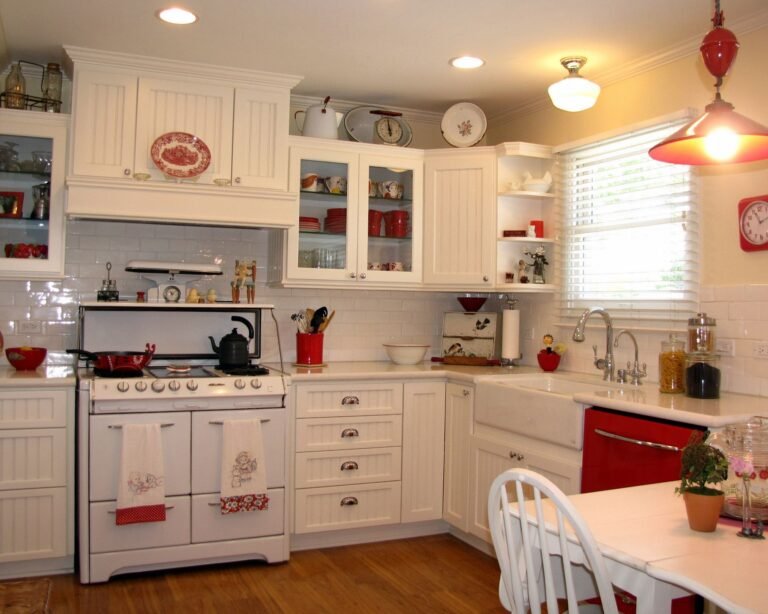
Everything else in the room answers to the sink. A generous apron-front farmhouse sink in fireclay or cast iron sets the tone before a single color has been chosen or a single texture introduced. Start here, then work outward.
10. Get the cabinet color right before anything else.
Warm white. Cream. Antique. Whatever the undertone, it needs to lean toward yellow and away from blue. Cold white makes a farmhouse kitchen feel clinical. Warm white makes it feel like it’s been lived in for a long time.
11. Use butcher block as a deliberate material choice.
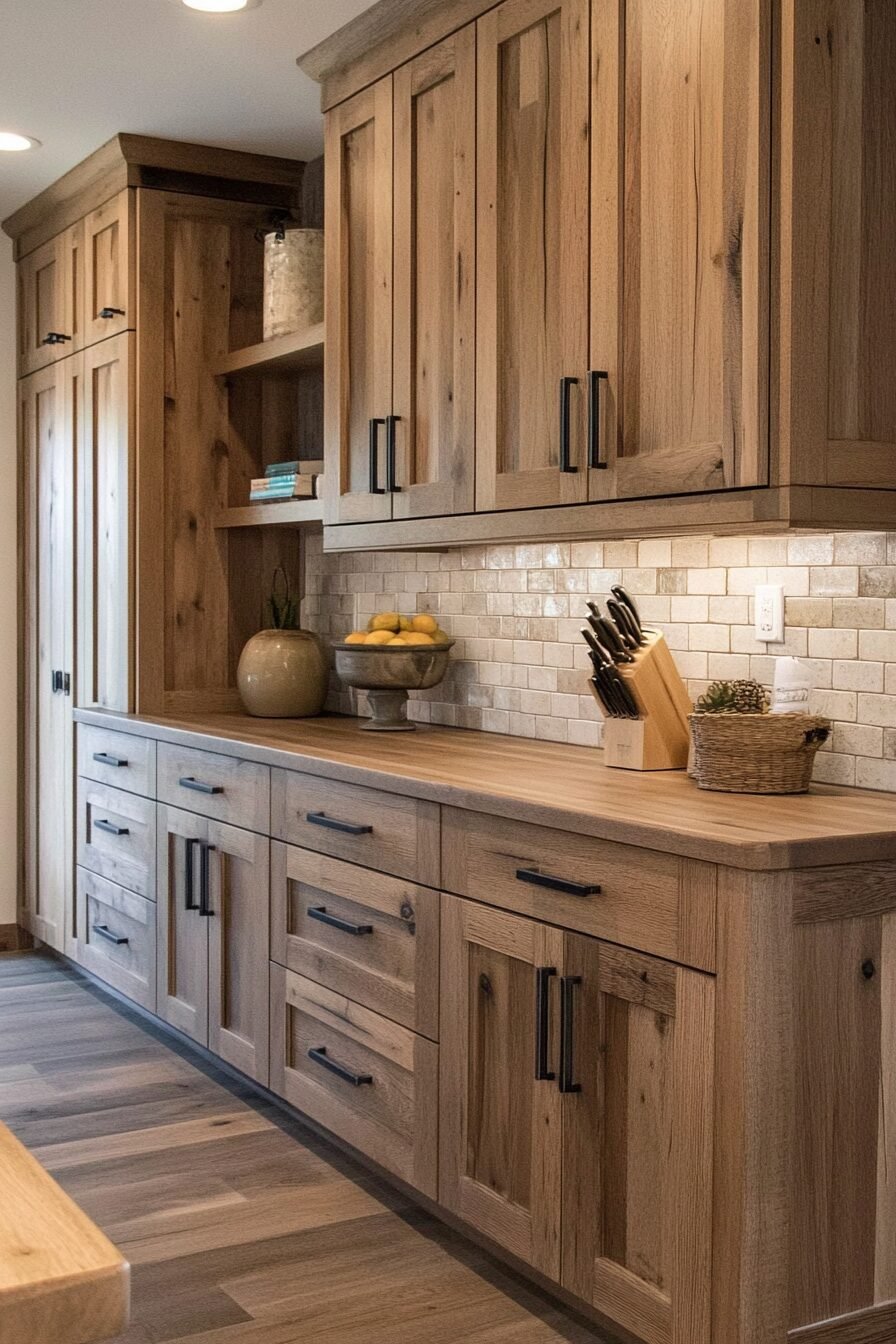
Not as a budget alternative — as a choice. Walnut or maple countertop on the island or prep area brings the kind of warmth that no manufactured surface can replicate. It’s also one of the few countertop materials that gets more beautiful with use.
12. Beadboard the island face.
The vertical grain of beadboard is one of the farmhouse kitchen’s most immediately recognizable signatures. Apply it to the island face, paint it out, and a plain box becomes a proper country kitchen feature in an afternoon.
13. Subway tile in a color that isn’t just white.
The shape is timeless. The color is a choice. Soft sage, smoky blue, warm oyster — a tile color that isn’t standard white means the backsplash is a decision, not a default. That difference shows.
The Island: How to Make the Kitchen’s Centrepiece Look Like It Means Something
14. Get an island that has legs.
Literally. Turned legs. A furniture-style profile. A furniture-style island that looks like it could stand anywhere in the house and hold its own. Built-in islands belong in contemporary kitchens. Furniture-style islands belong in farmhouse ones.
15. Style the surface with things that prove it gets used.
A cutting board resting against the backsplash. A container of wooden spoons. A linen cloth draped over the edge. The island surface is a document of the kitchen’s daily life. It should look like one.
16. Don’t match the seating.
A set of coordinated stools looks orderly. A set of varied ones looks like they gathered — which is more honest and more interesting. The slight mismatch signals a history that matching pieces can’t simulate.
Hardware and Fixtures: The Details That Declare a Point of View
17. Change the hardware across all cabinets and drawers.
Bin pulls. Cup pulls. Bin pulls. Solid knobs in matte black or dark bronze. This is the most impactful per-dollar change available in a kitchen where the bones are already in place. Do it all at once.
18. Hang something heavy and matte above the sink or island.
Black iron. Galvanized. A metal pendant light that looks like it belongs in a working building rather than a retail display. Farmhouse lighting should have substance. Anything polished or delicate reads as wrong.
19. Get the bridge faucet.
A bridge-style model in a finish that matches the rest of the hardware. Two handles. A visible connector. It’s a historically-grounded design that reads as considered rather than trend-chasing — which is exactly the signal you want.
20. Hooks under the upper cabinets, always.
For mugs. For towels. For whatever ends up in the wrong place repeatedly. Iron hooks or brass ones — either works. Visible storage with a farmhouse sensibility is always more interesting than hidden storage with an anonymous one.
Organized, Not Sterile: Keeping the Kitchen Tidy Without Making It Feel Like a Lab
21. Get the plates off the shelves and onto the wall.
A mounted plate rack with ironstone or stoneware in daily rotation. The dishes are seen, used, washed, and seen again. It’s the most natural display system imaginable and the most farmhouse thing you can do to an empty wall in a kitchen.
22. Contain the clutter with natural baskets.
Produce. Bread. The things that accumulate on counters regardless of effort. A woven basket contains the necessary chaos and adds texture to the surface it occupies. One basket. Problem solved. Aesthetic improved.
23. Hang the cookware on a pegboard.
Wooden, painted to blend. The most-used pots and pans at arm’s reach. It’s a working kitchen display system that doubles as a design feature — something that the farmhouse aesthetic has always been at its best when it leans into.
24. Decant the pantry staples.
Rice, flour, oats, sugar — all in coordinated glass jars with simple labels. A pantry shelf organized this way stops looking like a storage problem and starts looking like a still life. Minor effort. Major visual improvement.
Surface Work: The Wall and Ceiling Treatments That Add Real Character
25. Pull the upper cabinet doors off and open the shelves.
Open shelves lighten the room and require you to edit what goes up there. Style with restraint — a plate, a jar, a plant. Every open shelf in a farmhouse kitchen is an argument for fewer things, better chosen.
26. Shiplap one wall, behind the stove.
Painted to match or to blend. One textured wall. Shiplap used once, well, is a farmhouse detail. Shiplap used everywhere becomes a theme — and themes go out of fashion in ways that well-used materials never do.
27. Add beams to the ceiling.
Reclaimed, if possible. Well-made faux beams, if not. Either way, ceiling beams give a kitchen the feeling of having been built by someone who intended it to last — which is the whole philosophical underpinning of good farmhouse design.
28. Board-and-batten the eating area wall.
Floor to chair-rail. White or warm gray. It adds finish and depth to the room’s most social section and brings an architectural formality that offsets the more casual elements elsewhere.
29. One accent wall in an earthy color.
Sage. Clay. Denim. Greige. One wall in a grounding tone gives a white kitchen somewhere to land — and gives the eye somewhere to rest. Without it, an all-white kitchen risks feeling blank rather than bright.
The Gathering End: Making the Kitchen a Place People Stay
30. Build a bench into any available corner or nook.
Cushioned. Pillowed. Pulled up to a solid wood table. This becomes the spot. The one people gravitate toward in the morning and stay too long at in the evening. Every farmhouse kitchen deserves one.
31. Put a big round clock on the wall above the table.
Vintage-feeling. Slightly oversized. A round enamel wall clock like this grounds the dining area and signals something about how time moves in this kitchen — slowly, with room for second cups. That’s a message worth sending.
32. Keep a wooden tray on the table permanently.
A wooden tray with a candle, something seasonal, and the everyday condiments. It stays. Its contents rotate. The table always looks like it’s ready for something — because it is.
The Long Game: Why Farmhouse Kitchens Get Better Over Time
The kitchens on this list aren’t destinations. They’re starting points.
The best farmhouse kitchens are never truly finished. They accumulate. Objects come in and prove themselves over time. The ones that earn their place stay. The ones that don’t get replaced by something better.
Start with three ideas from this list. Come back when those are in place and pick three more.
That slow, layered approach is what produces a kitchen that couldn’t have been designed by anyone except you — because it wasn’t designed at all. It was built.