Kitchen Lighting That Actually Works: 29 Honest Recommendations
Disclosure : This post may contain affiliate links or paid partnerships. I may earn compensation if you click a link or make a purchase, at no additional cost to you. See my disclosure for more info.
Most kitchen lighting advice stays frustratingly vague.
“Layer your light.” “Add some warmth.” Fine in theory, useless in practice when you are standing in a kitchen that does not work.
This guide is different. Every idea targets a specific problem. Each one explains what it does and why it works. No padding, no filler — just 29 recommendations that deliver real results in real kitchens.
The Specific Ways Bad Lighting Makes a Good Kitchen Look Bad
Bad kitchen lighting is not just aesthetic. Shadows on the cutting board make prep work harder. Flat overhead light makes cooking uninspiring. Mismatched color temperatures make expensive finishes look inconsistent.
The fix requires three distinct types: ambient for room-level coverage, task for specific surfaces, and accent for depth and warmth. Each addresses a different failure mode. None can substitute for the others. Here is how to build each one.
Ambient Lighting: What Actually Covers the Room Properly
Ambient light is the foundation. Before anything else, the room needs a base layer that covers the full space evenly and adapts to different activities. If this is wrong, no other upgrade fully compensates.
1. Recessed lights on a dimmer
Recessed cans with a dimmer switch are the reliable standard for good reason. Even coverage. No visual competition with other fixtures. Adjustable for cooking, dining, and social use. Installing a dimmer where there was not one is a straightforward upgrade that changes how the kitchen works every day from that point forward.
2. Flush mount with frosted glass
For kitchens without recessed cans, a flush mount with a frosted diffuser is the practical alternative. Frosted glass prevents glare and hot spots. The difference between a clear and a frosted fixture is more significant than most people expect until they make the swap. Clear glass fixtures are almost always the wrong choice.
3. Semi-flush with a fabric shade
When warmth is the priority, a semi-flush mount with a linen or fabric shade outperforms glass alternatives. The shade absorbs and re-emits light softly, producing a kitchen that feels genuinely welcoming rather than merely functional.
4. LED panels for low-ceiling kitchens
Low ceilings need low-profile fixtures. Slim LED panels sit nearly flush, produce excellent even light, and preserve the full vertical space of the room. If you have low ceilings and bulky overhead fixtures, replacing them with flat panels is among the highest-return swaps available.
5. Cove lighting around the ceiling perimeter
LED strip lights in a ceiling cove bounce light upward, eliminating shadows, adding perceived height, and producing ambient light of a quality that feels noticeably more refined than direct overhead sources. A strong investment for any kitchen with the ceiling profile to support it.
Task Lighting: Solving Specific Real Problems
Task lighting addresses specific functional failures. Know your problem. Pick the appropriate solution.
6. Under-cabinet LED strips
The most universally valuable kitchen lighting upgrade that exists. Full stop.
Under-cabinet strips eliminate countertop shadows, make food preparation safer, and light the backsplash from an angle that makes it look its best. Adhesive LED kits are inexpensive and install in hours without an electrician. If your kitchen has one task lighting problem, this fixes it.
7. Under-cabinet puck lights
Use puck lights when you want focused spots rather than continuous coverage. They work well for kitchens where specific counter zones have different uses and benefit from distinct, targeted illumination.
8. Pendant lights over the island
Two or three pendants at 30 to 36 inches above the counter work for a reason: they light the prep surface and create a visual focal point above it simultaneously. Do not overthink the choice. Pick a style you like, hang at the right height, and the result will be effective.
9. Linear pendant over the island
If multiple pendants feel cluttered, a single linear suspension fixture running the full island length provides more uniform coverage and a cleaner visual. The right choice for kitchens that value simplicity.
10. Adjustable track lighting
Track lighting’s reputation is outdated. Modern track systems are slim, minimal, and genuinely useful — particularly for kitchens with irregular layouts or multiple work zones. The ability to redirect heads after installation means the system adapts when the kitchen’s needs change.
11. Swing-arm sconce near the cooking surface
Counterintuitive but highly effective. A swing-arm sconce beside the range solves the stovetop lighting problem more directly than any overhead alternative and adds a design detail that most kitchens entirely lack. Plug-in versions require no wiring.
12. Better bulbs in the range hood
The most neglected task light in most kitchens is the one already built into the range hood. Replace the stock bulbs with warm, high-output LEDs. The stovetop is immediately properly lit. Five minutes. Done.
Accent Lighting: The Layer That Creates Atmosphere
Accent lighting is the layer that most kitchens are missing entirely. Without it, a kitchen functions well but never feels quite right. With it, the room has depth, warmth, and genuine visual interest.
13. Interior lights for glass-front cabinets
Glass-front cabinets without interior lighting fail at their primary job. LED puck lights or strips inside complete what the glass door promises and make the display work at any hour.
14. Above-cabinet LED strips
The gap above upper cabinets that does not reach the ceiling is consistently squandered. LED strips on top of the cabinets aimed at the ceiling produce a warm indirect uplight with high reward for very low effort.
15. Toe-kick lighting under base cabinets
LED strips in the toe-kick channel create a floating floor effect that looks far more expensive than it is and provides a practical low-level glow at night. Dual function, single installation.
16. Shelf underlighting for open shelves
Open shelves without lighting are a daytime-only feature. LED strips under each shelf fix this completely. Displayed items remain visible and attractively lit at all hours.
17. Illuminated kickboard panels
Translucent panels that glow continuously at the base of the cabinetry are a high-commitment contemporary choice with an unmistakable and impressive effect. The light-at-floor-level aesthetic is unlike anything else.
18. Auto-illuminated deep drawers
Open a deep drawer and see everything in it, immediately. Battery-powered motion-triggered LED strips inside deep drawers install in minutes and feel, upon first use, like a feature every drawer should have had from the start.
Statement Fixtures: When One Choice Defines the Whole Room
A statement fixture is a design declaration. Chosen correctly, one piece communicates everything important about the kitchen’s personality.
19. One large commanding pendant
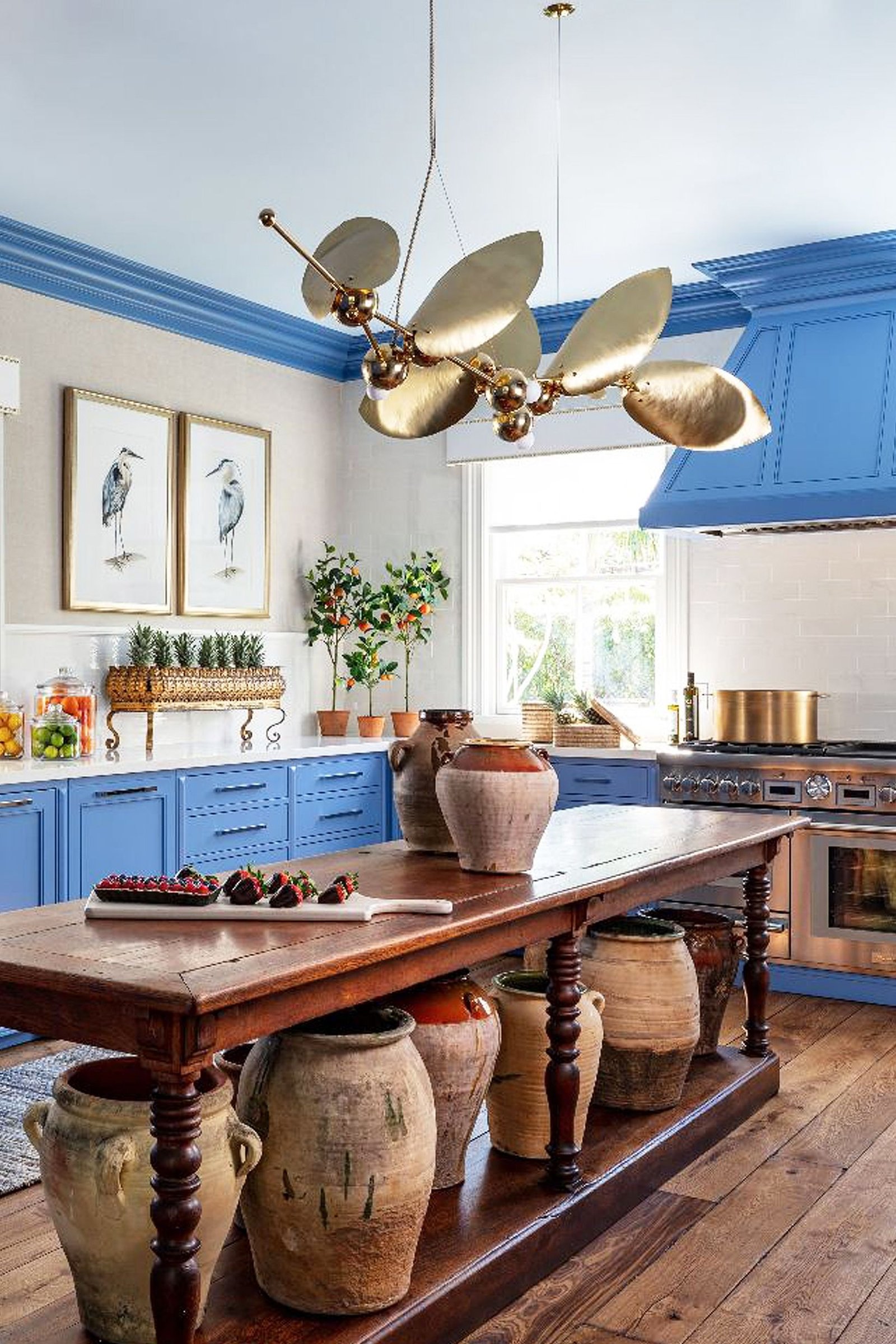
A single oversized pendant — woven rattan, blown glass, or sculptural metal — hung above the island gives the room a focal point it organizes around. One great fixture in the right position works harder than ten careful, undistinguished ones.
20. A chandelier above the kitchen dining area
A well-proportioned chandelier above the dining area defines the zone, gives it a sense of occasion, and makes eating there noticeably more pleasant. This is practical elegance, not pretension.
21. Lantern-style pendant lights
Lantern pendants work across more kitchen styles than almost any other pendant type. Open frame distributes light broadly, design heritage translates across aesthetics, and they tend to age exceptionally well. A low-risk, high-character choice.
22. A staggered pendant cluster
A cluster of small pendants at varied heights looks designed rather than installed. More visual movement overhead and far more interesting than the standard symmetrical row that every other kitchen has.
Smart Lighting: Options That Are Actually Worth It
Smart lighting is only worth adding when it solves a genuine problem. These four options consistently meet that test.
23. Smart bulbs with color temperature adjustment
Smart bulbs that shift between warm and cool tones on demand serve different kitchen functions without any fixture changes. Useful for kitchens used for both focused cooking and relaxed dining.
24. Motion-activated pantry and cabinet lights
No wiring. Battery-powered. Takes five minutes to install. Light turns on when the door opens. That is the entire case for these. It is sufficient.
25. Cabinet hardware with built-in LED strips
A specialty choice for contemporary kitchens. LED-integrated cabinet hardware produces a subtle continuous glow along cabinet fronts that communicates serious design intention without overpowering the rest of the room.
26. Solar tubes for natural light
If the kitchen lacks natural light, a solar tube is the most effective available alternative. A reflective conduit from roof to ceiling diffuser delivers genuine exterior daylight. The difference between natural and artificial ambient light is perceptible daily.
The Technical Parameters That Determine Whether Any of This Works
Get these wrong and the best fixtures underperform. Get them right and even modest fixtures perform well. They are not optional. They are foundational.
27. Every bulb in the kitchen must be 2700K to 3000K
This is the most important technical decision in kitchen lighting and the one most frequently ignored. Bulbs above 4000K create a clinical environment that is unpleasant to occupy for any extended period.
2700K to 3000K is warm, flattering, and universally appropriate for residential use. If you are using anything above 3500K in ambient or accent fixtures, this is the first thing to change.
28. Uniform color temperature everywhere, brightness varies
Mixed color temperatures in a single room create a persistent wrongness that most people notice without identifying. The solution: same color temperature in every fixture. Dimmers handle intensity. Temperature stays constant.
29. Under-cabinet lights at the front edge, not the back
Under-cabinet lights at the back of the cabinet base illuminate the wall, not the counter. The user stands between the light and the surface and casts a perfect shadow exactly where they need to see.
Install strips at the front edge of the cabinet base. This positions light correctly. No shadows. Full visibility. There is no good reason to deviate from this.
Why Fixture-First Thinking Produces Disappointing Kitchens
Most kitchen lighting projects fail the same way — not because the fixtures are bad, but because they were chosen before anyone thought clearly about what the kitchen actually needed.
Buying fixtures before auditing layers.
You find a pendant you like, buy it, hang it, and nothing changes. Counters still dark. Atmosphere still flat. The pendant is beautiful and doing nothing useful.
The order that produces results is strict: audit ambient, task, and accent. Identify the gaps. Choose fixtures that close those specific gaps. Every fixture must have a defined role. Every fixture must be positioned to fulfill it.
Your Kitchen Can Look This Good Without a Renovation
None of this requires new cabinets or a contractor. It requires clear thinking about what your kitchen’s lighting lacks and a small number of well-chosen upgrades that address those deficiencies in the right order.
Start with what is most obviously wrong. Fix that. Then look at what still does not work. Fix that. The kitchen you end up with — warm, well-lit, shadow-free, and visually layered — is the one your household has deserved all along.