27 Things to Know Before Buying a Living Room Chair (Design Tips That Actually Matter)
Disclosure : This post may contain affiliate links or paid partnerships. I may earn compensation if you click a link or make a purchase, at no additional cost to you. See my disclosure for more info.
You’re about to buy a chair.
Or you already bought one and it’s not working.
Either way — you’re in the right place.
Most chair-buying guides focus entirely on product specifications. Dimensions, foam density, fabric weight. They tell you what the chair is, not how to make it work in your actual room.
This guide does something different. It tells you the twenty-seven things that determine whether your chair purchase will actually transform the living room — or just add another piece of furniture to a room that still doesn’t feel right.
Because the chair is almost never the problem by itself. The problem is everything surrounding the decision: how it relates to the other furniture, where it sits in the room, what material it’s covered in, whether anyone considered the back of it.
Get those things right, and almost any chair can work.
Get them wrong, and even an expensive one won’t help.
Here’s what you need to know before — and after — you buy.
Before You Buy: Scale and Form Decisions
1. Tape the footprint on your floor before placing an order.
This is the single most important pre-purchase step, and almost no one does it.
Product dimensions are accurate. Your mental image of how those dimensions translate into your room is almost never accurate. Tape the chair’s width and depth on your actual floor. Look at it from every entry point. Check whether it blocks any pathways. Then decide.
2. Check whether the room needs a curved form to balance angular furniture.
Before buying another rectangular chair, look at your room honestly. Is everything already boxy and straight? If so, a rounded or barrel-back chair will do more for the room’s visual balance than another right-angle piece ever could.
3. Decide whether the room needs a lower chair for better proportions.
If your living room has standard eight-foot ceilings and currently feels low or cramped, low-profile seating may be the most effective intervention.
Chair height affects room height perception. This is a design decision, not just a comfort preference.
4. Verify the legs will let the floor show.
Before finalizing a chair, look at the base. Open, exposed legs — tapered, slim, hairpin — preserve the visual openness of the floor beneath. Fully skirted chairs or solid platforms eliminate that openness. In most rooms, the floor is an asset. Buy a chair that lets it remain one.
5. Decide if the room needs a single commanding anchor piece.
If the seating group currently lacks a visual center, consider whether a deliberately generous chair — a broad wingback or deep club chair — would organize the room better than another mid-size piece would. One deliberate anchor is worth more than three carefully chosen accents.
The Fabric and Color Decision: What to Know First
6. Buy contrast, not coordination.
If the chair you’re considering is the same tone and material as your sofa, stop and reconsider.
A room where everything matches reads as unlayered. Contrast creates the visual complexity that makes a room look designed. Choose something that complements the sofa in a different direction — different depth, different temperature, different material weight.
7. Consider a textured neutral if bold color feels like a risk.
Textured chairs — bouclé, velvet, nubby woven linen — add depth to a room without committing to a saturated color.
This is the middle path between matchy-safe and boldly risky. Most rooms benefit from it.
8. Seriously consider performance fabric for any high-use room.
If anyone in your household has ever spilled anything on furniture — and they have — performance upholstery is worth the conversation.
Modern performance fabrics look indistinguishable from premium upholstery. They resist staining and wear in ways that preserve the design intention of the chair over years of actual use. This is a functional decision with direct aesthetic consequences.
9. Know before you buy whether the room needs a color anchor.
If the room currently reads as tonally flat — all neutrals, all the same temperature — then a chair in one deliberate, committed color can resolve that in a single purchase.
Decide before you buy: is this chair that anchor, or is it supporting something that already serves that role? Every room needs one. Not every chair should be one.
10. Don’t overlook leather as a long-term investment.
A quality leather chair costs more initially and rewards that investment over a much longer timeline than most fabric upholstery.
Leather develops patina with use. It becomes more characterful, not less. If you can afford one leather piece, it’s often the highest-value purchase in the room.
11. Check the back of the chair before buying.
Turn the product photo around if you can. Request a back view. Ask before ordering.
If the chair is going to float away from the wall, its back will be visible constantly. A beautifully detailed back — visible joinery, tufted upholstery, carved frame — doubles the chair’s design value. A flat, unfinished back in a floating position is a daily reminder of what wasn’t considered.
Placement: What to Know Before the Chair Arrives
12. Plan to pull the chair away from the wall before the delivery truck arrives.
Decide in advance: where will this chair actually sit? Not against the wall, if the room can help it.
Furniture pushed to the perimeter empties the center and makes the room feel like a lobby. Chairs pulled into the room create a zone. Plan the zone before the chair arrives.
13. Know the conversation angle before positioning.
A chair placed at thirty to forty-five degrees facing the sofa creates a natural social geometry. A chair placed parallel to the sofa or facing a wall doesn’t. Decide the angle before the chair touches down. Repositioning after is easier when the first placement is intentional.
14. Consider whether this chair could become a reading nook anchor.
A reading corner — one chair, one side table, one floor lamp — gives a room a second zone.
If the chair you’re buying could serve that function, plan the accessories in advance. A reading corner is worth more to a room than a fourth accent chair in the central seating group.
15. Check whether you have a fireplace that needs flanking.
If your living room has a fireplace, two matching chairs flanking it is one of the highest-return layout moves available.
Ask yourself: is this chair one of that pair? If so, what’s the other chair? Buy them together if possible. Flanking works best when the chairs match or closely complement one another.
16. Decide what zone edge this chair will mark.
In an open-plan home, every seating piece implicitly defines the boundary of the living zone.
Know before placing the chair: is it part of the central seating cluster, or is it defining the outer edge of that zone? Placement that answers this question clearly produces better-looking rooms than placement that doesn’t.
17. Identify your room’s best view and orient the chair accordingly.
Where does the best light come from? Where is the garden, the skyline, the interesting architectural feature?
Your primary accent chair should face that. Comfort aimed at something worth looking at is the combination that makes a room feel like somewhere a person actually wants to be.
What Makes a Chair Look More Expensive After You Buy It
18. Budget for leg replacement when you buy from accessible price points.
This is the single most effective post-purchase upgrade available.
Mid-range chairs almost always ship with legs that broadcast their price point. Replacement legs — walnut tapers, brass caps, matte powder-coat — cost under twenty dollars and take less than twenty minutes to install.
Plan this upgrade when you buy, not after you’re disappointed.
19. Buy one lumbar pillow in a contrasting material at the same time as the chair.
Buy the chair. Buy the lumbar pillow simultaneously.
A single pillow that contrasts the chair’s material — textured on smooth, warm on cool, velvet on linen — completes the chair’s appearance from the moment it arrives. It costs almost nothing relative to the chair and immediately levels up the entire piece.
20. Prioritize craft details in the chair selection itself.
At comparable price points, always choose the chair with visible craft over the one without it.
Nail-heads. Exposed wood frames. Visible structural details. These signal quality and communicate that the room was worth caring about. That signal compounds — the chair makes the room read better, and the room makes the chair look more appropriate.
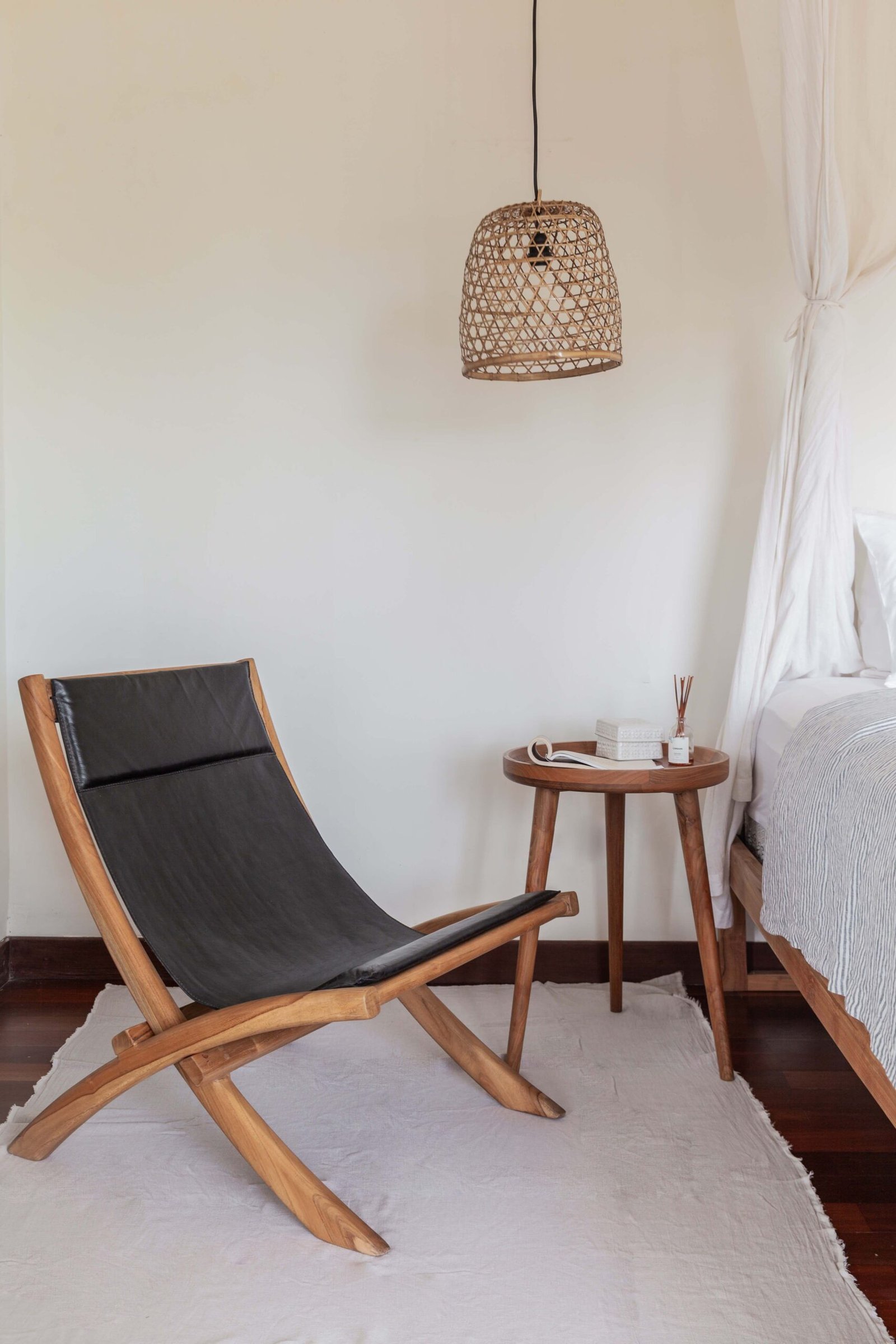
21. Buy at least one chair with an unusual, compelling silhouette.
At some point in your living room, there should be one chair that is simply interesting to look at.
A form that curves unexpectedly. A structure that does something a standard chair doesn’t. A profile that reads as designed, not just manufactured. That chair elevates the room in a way that no accessory, no art, no rug can replicate.
What to Know About How the Chair Will Actually Be Used
22. Consider a swivel base for multipurpose rooms before buying a fixed-base chair.
A swivel chair adapts to every activity the room hosts. It’s not just more convenient — it’s a different category of seating in a room that does multiple things.
If you’re undecided between a fixed and swivel base, and the room serves more than one function daily, swivel is almost always the better choice.
23. Know whether you also need an ottoman before you complete the order.
A chair and an ottoman together create something a chair alone can’t: a genuine lounge destination.
If relaxation is what the room is supposed to enable, buy the ottoman at the same time. It’s easier to pair correctly before delivery than to find a match afterward.
24. Own a throw before the chair arrives.
A throw draped over an arm is the finishing touch that makes a chair look styled and inhabited from day one.
Have it ready when the chair is delivered. You’ll be glad immediately.
The Mistakes That Can’t Be Fixed After Purchase
25. Never buy a chair you wouldn’t actually sit in for two hours.
Visual appeal is not enough. Not in a living room.
Sit in every chair before buying — or buy from retailers with reliable return policies for exactly this reason. If the chair isn’t comfortable enough for a normal evening, it will never be used, and it will never stop communicating that fact.
26. Test seat depth specifically, not just overall comfort.
Seat depth determines posture. Too deep: occupants slide forward or pile pillows behind them. Too shallow: it feels impermanent and tiring.
Sit all the way back. Feet should rest flat on the floor. This test matters especially for anyone in your household who is shorter than average. Measure. Don’t assume.
27. Plan for seasonal rotation before you commit to a permanent arrangement.
The best living rooms evolve. They don’t freeze.
Consider whether the chair you’re buying is a year-round anchor or a seasonal piece. A rattan or woven chair works beautifully in summer. A velvet seat comes into its own in winter. Two chairs rotated seasonally do more for a room than one static piece ever will.
The Decision Behind the Decision
Here’s what these twenty-seven tips are actually pointing toward:
A chair purchase is not just a product decision. It’s a design decision — one that affects the scale, mood, function, and feeling of the entire room around it.
When you treat it that way, the result is a room that actually works. A room that feels designed, not just furnished. A room that still looks good in two years, not one that looks dated in six months.
Apply even three of these tips to your next purchase and the difference will be visible.
Apply ten of them and the room will look like someone you admire on Instagram actually lives in it.
Start with whatever feels most actionable. One decision. Made better. This weekend.