25 Bookcase Styles Worth Knowing (And How to Pick the Right One for Your Space)
Disclosure : This post may contain affiliate links or paid partnerships. I may earn compensation if you click a link or make a purchase, at no additional cost to you. See my disclosure for more info.
A bookcase is one of the most impactful pieces of furniture you can bring into a room — and also one of the easiest to get wrong.
Done right, it creates visual structure, adds warmth, and makes the room feel considered and complete. Done wrong, it just takes up wall space while contributing nothing.
The difference between the two outcomes almost always comes down to one thing: choosing a style that matches not just the dimensions of your wall, but the character of your room.
This guide covers 25 bookcase styles that deliver genuine design value, along with guidance on where and how each one works best.
What to Think About Before You Buy
Before we get into the styles themselves, a few things worth knowing.
Most people choose bookcases based on how much storage they need and how much they’re willing to spend. Both factors matter. But the most important question is actually: what do I want this bookcase to do for the room?
A bookcase engages the vertical plane of a room in a way that most other furniture doesn’t. It shapes how the wall feels. It creates a focal point. When the right style is chosen for the right context, the whole room benefits.
Keep that in mind as you go through these 25 options.
Open Designs for Light, Airy Spaces
1. Floating wall-mounted cube shelves
Best for: Small rooms, modern apartments, homes where floor space is at a premium.
Floating cube shelves attach directly to the wall, keeping the floor beneath completely clear. The visual result is a lighter, more spacious-feeling room. They can also be configured to double as a room divider.
2. Leaning ladder bookcase
Best for: Narrow hallways, guest rooms, corners where you want storage without visual bulk.
A ladder bookcase leans against the wall rather than standing away from it. The result is relaxed and minimal — a piece that feels deliberate without trying too hard.
3. Asymmetric open shelving unit
Best for: Living rooms, home offices, anywhere you want visual interest without complexity.
Variable shelf heights and irregular widths create movement and energy. This type of unit tends to generate more compliments than any other format on this list.
4. Tall narrow tower bookcase
Best for: Underutilized corners, rooms with limited floor space but high ceilings.
A tower bookcase makes use of vertical rather than horizontal space. It draws the eye upward, which has the optical effect of making the ceiling feel higher than it is.
Statement and Focal-Point Designs
5. Mid-century modern bookcase on tapered legs
Best for: Living rooms, studies, any space with a warm or eclectic palette.
Warm wood tones, clean proportions, and elegant legs give this style a timeless quality. It has broad stylistic compatibility and works in both contemporary and more traditional settings.
6. Steel-and-wood geometric bookcase
Best for: Rooms where you want the bookcase to be the visual anchor, modern or industrial-leaning interiors.
The combination of black metal framing and natural wood creates a strong industrial-modern character. This format demands wall space and delivers strongly in return.
7. Arched-top bookcase
Best for: Rooms with predominantly angular or rectilinear furniture, spaces that feel slightly cold or rigid.
An arch-topped bookcase introduces organic curves that soften the geometry of a modern room without looking out of place.
8. Glass-fronted display cabinet
Best for: Displaying ceramics, collectibles, travel pieces, or curated books with beautiful covers.
Glass panels protect contents while keeping them visible. The effect is closer to a gallery vitrine than standard shelving — ideal when the objects on display merit that level of attention.
The Built-In Look at a Fraction of the Cost
9. Tall freestanding bookcase (painted to match the wall)
Best for: Rooms where you want the built-in aesthetic without the cost of custom joinery.
A tall, frameless freestanding bookcase placed flush to the wall and painted the same color is one of the most effective visual tricks in residential design. The seam between bookcase and wall virtually disappears.
10. Paired bookcases flanking a fireplace
Best for: Living rooms with a chimney breast or any room with a clear central focal point.
Two matched bookcases placed symmetrically either side of a fireplace create an architectural moment that transforms a plain wall into a designed feature.
11. Alcove bookcase with overhead lighting
Best for: Recessed nooks, chimney alcoves, any underused cavity in the wall.
A slim bookcase fitted into an alcove, with a concealed LED strip running behind the top shelf, transforms dead space into a warm, atmospheric feature. The combination of storage and light is particularly effective in the evening.
Smart Solutions for Compact Homes
12. Corner bookcase
Best for: Rooms where corners are currently contributing nothing.
A corner bookcase wraps around the junction of two walls and converts consistently wasted floor area into practical storage and genuine visual interest.
13. Low behind-sofa bookcase
Best for: Open-plan living rooms, rooms with a sofa that floats away from the wall.
The gap between the back of a sofa and the wall is usually empty. A low horizontal bookcase fills it without obstructing sightlines, providing a display surface on top and enclosed storage for baskets within.
14. Face-out cover-display bookshelf
Best for: Hallways, bathrooms, beside beds in rooms without space for a nightstand.
Books presented cover-forward rather than spine-out become part of the room’s visual composition. The shelf depth required is minimal, making this format viable in spaces where standard shelving won’t fit.
15. Under-staircase bookcase
Best for: Homes with staircases where the triangular space beneath is currently storage for clutter or nothing at all.
A properly fitted bookcase under the stairs looks architectural and intentional. It maximizes a volume that most homes waste entirely.
High-Contrast and Sculptural Options
16. Dark bookcase on a dark-painted wall
Best for: Rooms with a bold or moody color scheme, spaces where you want maximum visual depth.
Tone-on-tone placement — dark bookcase against a dark wall — creates a layered depth effect that makes objects on the shelves appear to emerge from the background. The result is sophisticated and unmistakably deliberate.
17. Sculptural organic-form bookcase
Best for: Rooms with a bold design brief, spaces where you want the furniture to function as art.
Curved, non-rectilinear bookcases are not for every home. But in the right context — a room confident enough in its own identity to support a strong statement piece — they are extraordinary.
18. Rotating freestanding bookcase
Best for: Studio apartments, open-plan rooms where zone definition is needed without permanent walls.
A rotating bookcase provides omnidirectional access and doubles as a moveable room divider. It is also, without exception, a conversation piece.
19. Color-blocked painted bookcase
Best for: Anyone willing to invest a weekend in a DIY project that produces disproportionate visual results.
A plain bookcase, with individual compartments painted in different considered colors, becomes a graphic composition entirely distinct from its original form.
Bookcase Applications Beyond the Living Room
20. Kitchen bookcase
Best for: Kitchens that need character as much as counter space.
A slim open bookcase in the kitchen — holding cookbooks, ceramics, and a plant — brings warmth and personality to the room that needs it most and gets it least.
21. Bedroom bookcase headboard
Best for: Bedrooms where a conventional headboard feels like a missed opportunity.
A low, wide bookcase running behind the bed replaces both headboard and bedside tables in one move. Integrate a reading light and the wall behind the bed becomes a complete, considered composition.
22. Bathroom ladder shelf
Best for: Bathrooms that feel purely functional and could use a design moment.
Towels, candles, plants, and a book or two. Unexpected placement in an unexpected room. Exactly the kind of decision that makes a bathroom feel like someone thought about it.
23. Entryway bookcase
Best for: Entry halls and front rooms where you want to set the tone immediately.
A slim entryway bookcase, styled with a tray, a small vase, and two or three objects, establishes the aesthetic register of the entire home before a guest has seen anything else.
Two Styling Rules That Make Any Bookcase Look Better
The bookcase is chosen. Now comes the part most people underestimate: styling the shelves.
Two rules are worth knowing:
24. Three objects per grouping, always
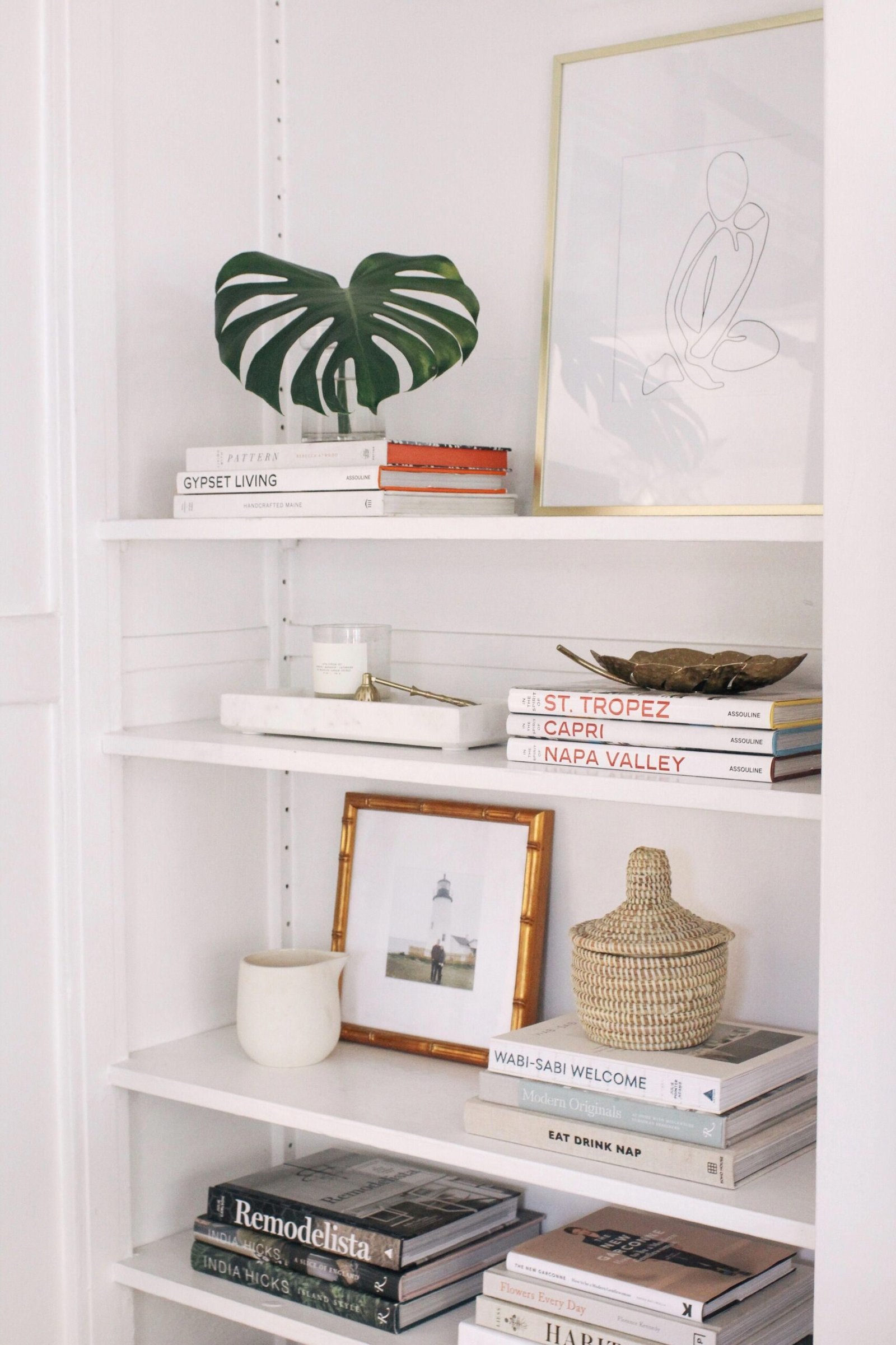
Group objects in sets of three: a stack of books, a plant, a ceramic object. Each at a different height. The visual triangle this creates is the most stable compositional unit in shelf design. It reads as intentional every time.
25. Vary your book orientations
Alternate between upright rows and horizontal stacks across different shelves. The horizontal stacks become platforms for smaller objects placed on top — a candle, a framed print, a small sculpture. The result is a shelf that reads as designed rather than merely organized.
One Final Rule: Get the Scale Right
All of the above works only if the scale is correct.
An undersized bookcase on a large wall looks unconfident. An oversized one in a small room feels oppressive. The sweet spot: roughly two-thirds of the available wall width. Where a smaller unit is intentional, balance it with art, lighting, or a plant to complete the visual weight.
Scale correct — everything else falls into place.
Your Next Step
Twenty-five bookcase styles, each suited to a different context and design objective.
Identify the one that fits your space, your style, and the gap your room has been missing. Measure the wall. Commit to the piece. Style it with care.
The rooms that feel truly finished usually got there through one clear, well-executed decision.
This is often that decision.
Start here.