28 Japanese Bathroom Secrets That Make Your Home Feel Like a Ryokan
Disclosure : This post may contain affiliate links or paid partnerships. I may earn compensation if you click a link or make a purchase, at no additional cost to you. See my disclosure for more info.
You come through the door and your whole body is heavy.
Your jaw is tight. Your mind hasn’t stopped since this morning. Your to-do list is longer than when you started.
You push open the bathroom door, scan the room, and feel… nothing shifts.
No exhale. No release. Just a room that asks nothing of you but gives nothing back.
What if it didn’t have to be that way?
Japanese ryokan inns have been offering guests a particular kind of restoration for centuries. The secret is not expensive architecture or rare materials. It is a set of deeply considered design principles that prioritize the person in the room above everything else.
And those same principles? They apply perfectly to a home bathroom.
No architect required. No full renovation necessary.
Here are twenty-eight of them.
The Ryokan Mentality Behind Japanese Bathroom Design
What makes a ryokan bath so different from a regular bathroom is the underlying intention.
In Japan, the bath is not a functional obligation. It is a transition ceremony.
You are washing away not just dirt but the weight of the day. The design supports this — every element, from material choice to light temperature to spatial flow, is chosen to deepen the transition.
The environment says: you can let go now.
You can replicate this. And once you do, your bathroom will never feel the same way twice.
Spatial Organization
1. Define a clear boundary between washing and changing zones
In traditional Japanese homes, these are distinct rooms. The principle: moisture stays where it is generated.
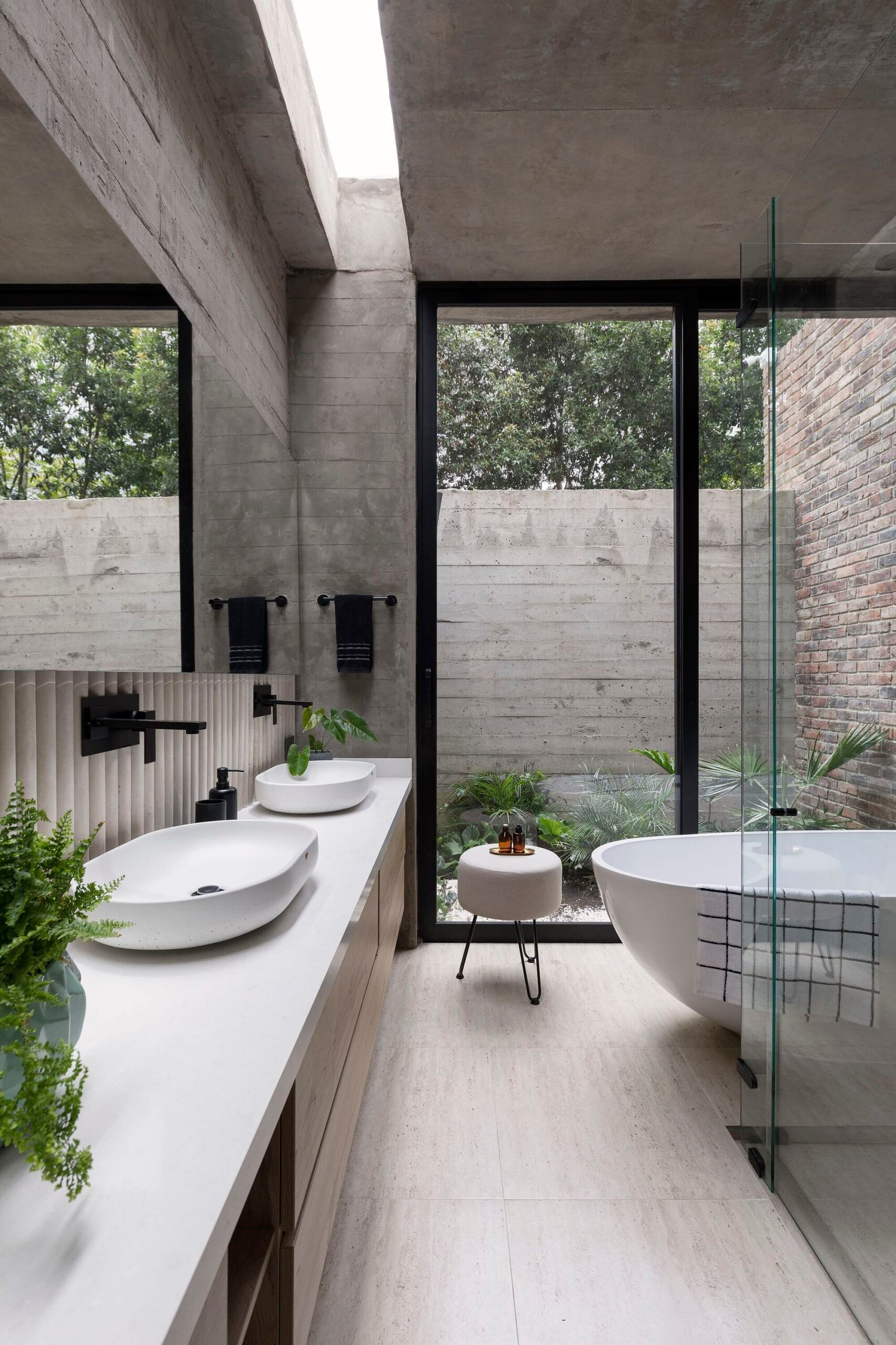
A simple glass panel or a subtle step down at the transition point establishes this separation even in a compact space. The bathroom stays drier, cleaner, and noticeably more composed.
2. Place the soaking tub where it cannot be overlooked
In ryokan design, the bath is never incidental. It is the room’s entire reason for being.
Position your soaking tub where it is the first and only thing you see when you walk in. Everything else arranges itself around it.
3. Set up a pre-bath washing station
In Japanese bathing culture, you wash yourself completely before entering the tub. The soak is not for cleaning — it is for healing.
A low-set shower station with a handheld spray and a wooden bathing stool enables this practice simply.
4. Remove the toilet from the bathing environment
A sliding door or partial wall is all it takes.
Once separated, the bathing area shifts in character entirely. From multi-purpose utility room to dedicated recovery space.
The Language of Natural Materials
5. Let hinoki cypress set the tone for the whole room
No other material says Japanese bathing culture more directly than hinoki. Naturally waterproof. Naturally mildew-resistant.
And when it meets steam, it releases a warm, resinous, citrusy fragrance that is impossible to replicate synthetically.
A hinoki mat, a bathing stool, or a tray at the tub edge brings this atmosphere into your daily life.
6. Ground the room with natural stone surfaces
River pebbles, smooth slate, or textured stone tiles on the floor create a physical and visual bond with the natural world.
Walking on a pebbled floor barefoot is not just beautiful — it is a daily practice in sensory grounding that your body quietly appreciates.
7. Choose matte surfaces throughout
Glossy tiles reflect everything back at you — light, movement, visual noise. They belong in showrooms, not sanctuaries.
Matte finishes on tiles, fixtures, and counters absorb light. The room feels quieter, warmer, more human.
8. Use washi-inspired textures on the walls
Paper washi cannot live in a wet room. But textured wall panels that carry its soft, layered character bring the same warmth to the space.
It is a detail you feel before you notice it. Which is exactly right.
Water as the Centerpiece
9. Install an authentic ofuro deep soaking tub
This is the essential piece. Without it, the Japanese bathing experience is approximated at best.
The ofuro design is deeper and more compact than a Western bathtub. You sit upright in it, shoulders submerged, fully enveloped by hot water.
It is not like bathing in a Western tub. It is a completely different physical and mental experience. A deep soaking tub is the foundation of everything else on this list.
10. Fit a rain showerhead directly above the shower zone
A ceiling-mounted rain showerhead delivers water from directly above in a wide, even spread.
Not angled. Not pressurized. Just water falling the way it is supposed to fall.
This is how a shower becomes a sensory experience rather than a task.
11. Add a height-adjustable handheld wand
A sliding rail mount makes the showerhead work at any height — standing, sitting, or somewhere in between.
Flexibility supports the Japanese practice of thorough, deliberate pre-soak washing.
12. Include a water feature for ambient sound
Moving water is one of the defining sonic textures of Japanese spaces. The shishi-odoshi bamboo fountain in the garden. The drip of a stone basin in a tea house.
A small indoor fountain placed near the tub delivers that same acoustic layer — a sound that tells your brain to stop bracing and start resting.
Lighting as a Tool for Transition
13. Dim everything and warm everything
Bright white light keeps your nervous system in alert mode. That is the last thing you need at the end of the day.
Warm LED strips concealed behind mirrors or beneath floating vanities, paired with a dimmer switch, let you dial the room down to the level your body actually needs.
14. Add a backlit mirror for atmospheric glow
A backlit vanity mirror wraps the space in soft, even light that is flattering to the eye and calming to the mind.
It is one of those changes that makes a room feel like somewhere different from the moment you first see it.
15. Use lantern-style light sources or candles
Pendants inspired by Japanese paper lanterns, or simple candle holders at the tub edge, create the flickering warmth that tells your nervous system it is safe to let everything go.
Intentional Minimalism
16. Keep every surface clear of unnecessary objects
The visual weight of a cluttered bathroom presses against your nervous system even when you don’t consciously register it.
Floating vanities with soft-close storage, recessed niches, and concealed cabinets keep all your products accessible and entirely out of view.
17. Use an exceptionally restrained color palette
Warm white. Stone grey. Natural linen. Pale timber.
Three tones maximum. No statement colors. No decorative patterns.
Tonal restraint creates the feeling of boundless space — which in turn creates the feeling of calm — even in the smallest of rooms.
18. Let one beautiful object stand alone
One ceramic vessel. One well-chosen soap dish. One flower in a slender vase.
“Ma” — the Japanese concept of purposeful negative space — holds that the space around an object is as much a design element as the object itself.
19. Standardize your towels in one neutral color
A bathroom with mismatched towels looks chaotic regardless of everything else.
One shade, one texture, arranged neatly on an open wooden shelf. This single change has an immediate and outsized impact on the room’s overall feel.
Nature as a Living Design Element
20. Position a humidity-loving plant near the tub
Ferns, peace lily, pothos, bamboo — these plants genuinely thrive in bathroom humidity. They require almost nothing and give a great deal in return.
One green presence near the water connects the room to the living world. This is “shizen” — natural beauty that arrives without effort.
21. Bridge nature and bathing with a bamboo tray
A bamboo caddy across the tub carries a cup of green tea, a book, or a single tealight.
It is a small thing. But it signals to your mind that this time is yours. That it is worth slowing all the way down.
22. Give yourself something natural to look at
A window with frosted glass is the ideal. Natural light, without exposure.
No window? A framed nature photograph — a fog-covered forest, a still river, a mountain at dusk — gives your eyes a restful destination when your mind is finally quiet.
The Final Sensory Layer
23. Install a heated towel warmer
A warm towel after a deep, long soak is quietly one of the greatest small luxuries a home can offer.
A wall-mounted heated rack is inexpensive, installs in an afternoon, and transforms every bath for the years that follow.
24. Hang botanical shower bundles
Eucalyptus or cedar tied near the showerhead releases natural oils in the steam. The fragrance that fills the room is clean, forest-like, and entirely without synthetics.
No device. No electricity. Just nature and heat.
25. Warm the floor before you step out of the tub
Cold tile on warm, bare feet shatters the entire experience of a good soak.
Radiant underfloor heating is the best solution. For something immediate, a quality wooden bath mat placed directly beside the tub handles it elegantly.
26. Treat sound as a design material
A waterproof Bluetooth speaker set to ambient rainfall, traditional Japanese music, or white noise actively shapes the acoustic environment of your bathroom.
Visual design draws most of the attention. Sound does much of the actual work of relaxation. Use it deliberately.
27. Find your signature bathroom scent
Not a commercial fragrance product. Something quieter.
A hinoki wood chip in a ceramic bowl. A single incense stick lit before you enter. A drop of pine or cedarwood oil in warm water.
Japan’s “kodo” — the practice of fragrance as ceremony — treats scent as an active path to mindful stillness, not decoration.
28. Hang a robe or yukata where you will reach it easily
The ritual should not end with the drain.
A light cotton or linen robe hanging on a simple wooden hook carries the warmth of the bath forward. From water to warmth without breaking the experience in two.
What You’re Really Building Here
You are not redesigning a bathroom. You are building a room that pays you back every day you use it.
A private ryokan. A daily transition ceremony. Twenty minutes of genuine restoration before the day starts or ends.
Japan figured this out a long time ago. The bath is not maintenance. It is a daily act of care for yourself.
And you deserve a room designed with that purpose in mind.
Pick one idea. Make it real. Then let intention guide the next choice, and the one after that.
Because every choice you make with that intention is a choice in favor of your own daily restoration.
That is not a small thing. Start building it now.