Sophisticated Console Table Picks That Bring Instant Designer Flair to Any Room
Disclosure : This post may contain affiliate links or paid partnerships. I may earn compensation if you click a link or make a purchase, at no additional cost to you. See my disclosure for more info.
There’s a moment that happens to almost every homeowner.
You walk through someone else’s entryway and feel something. Not envy exactly — more like recognition. Like you’re seeing something your own home could be but isn’t yet.
You’ve collected visual references for months. You’ve walked into furniture showrooms and quietly done the math on pieces you couldn’t justify.
And yet the wall stays empty. Or worse: occupied by something that doesn’t deserve to be there.
The reality about luxury console tables: what makes them look expensive is not how much they cost. It’s what they do visually. How they occupy space. The materials, the silhouette, the relationship with everything around them.
Learn those principles and you can recreate the result at almost any budget.
That’s the conversation we’re having here.
From sprawling foyers to narrow apartment hallways — these ideas will transform your entry from background to foreground. From forgotten to unforgettable.
What Your Console Table Is Actually Telling Your Guests
Before we talk about specific pieces, consider what’s actually happening at your entryway every time someone visits.
The console table is the first furniture anyone encounters when they cross your threshold. It arrives before the living room, before the kitchen, before any other carefully considered piece in your home.
In the span of a single glance, it communicates your taste, your care, your sense of what’s worth attention.
Most people treat it as residual — a place for accumulation rather than intention.
That’s the equivalent of greeting guests at the door in yesterday’s clothes.
Your console table is your home’s first handshake. Make it confident, warm, and worth remembering.
1. The Raw Stone Console That Turns Any Entry Into an Experience
There’s a reason the most coveted consoles in architectural photography are almost always stone.
Marble, travertine, cast concrete — these materials carry geological authority. They’re not manufactured in a factory and shipped in a box. They’re cut from something that took millions of years to form.
That reality communicates itself to anyone who looks at them. It’s not conscious — it’s felt.
A sculptural stone console needs no supporting elements. No carefully chosen mirror. No elaborate styling.
Its mere presence transforms the entry into something that feels considered and permanent.
Look for forms with organic personality — rounded edges, sweeping arches, silhouettes that suggest a maker’s hand. A marble waterfall console in creamy Calacatta plus a single ceramic vase — and the composition is complete.
2. The Airy Metal-and-Glass Console That Maximizes Tight Corridors
Not all entryways are created equal. Some are pinched and narrow — barely functional as traffic routes, let alone as design canvases.
That doesn’t matter here.
A glass-topped brass console is virtually invisible in tight spaces. The transparent surface doesn’t contribute to visual congestion. The warm brass frame provides the sophistication the space needs without occupying any perceived volume.
Target a depth of 10 to 12 inches. Functional for a lamp and a tray. Slim enough that the hallway remains usable.
Genuine style is always possible. Space is just a variable, not a barrier.
3. The Fluted Console That Gives Your Entry Architectural Personality
Smooth, uninterrupted surfaces have a fundamental weakness: they’re passive. The eye slides right past them.
Fluting — the repeated vertical grooves carved into wood or stone — creates active surfaces that reward looking. Borrowed from classical architecture, this technique has found its way onto the most coveted modern furniture for good reason: it works.
A natural oak fluted console in warm amber. A mango wood piece with deep, expressive channels. Either one creates light-and-shadow play that gives the surface dimension and movement no flat piece can match.
4. The Arched Console That Lends Softness to Angular Spaces
Arched forms have become the defining feature of contemporary high-end design. You see them in mirrors, in doorways, in built-in shelving. The visual language of curves is everywhere right now.
But the arched console base is the iteration that surprises — and delivers outsized impact as a result.
A single sweeping curve or a series of smaller arches introduces intimacy and elegance that straight furniture cannot provide. It makes the entry feel welcoming in a specific, architectural way.
Place a clean-lined rectangular mirror above to contrast the curve with the geometric frame — a classic design pairing that generates productive visual interest.
5. The Floating Console That Gives Your Entry a Light, Considered Feel
One quality that reliably marks a professionally designed space: no surface is left unconsidered. Including the floor beneath the furniture.
A wall-mounted console uses the gap between itself and the floor as a deliberate design gesture. The space below the table isn’t dead zone — it’s breathing room that makes the whole entry feel lighter.
And yes, it’s easier to run a mop under. But that practical bonus misses the real point entirely.
The real point: the room feels edited with intention and precision. The floating effect signals that every detail was a choice.
Style the top simply — a candle, one book, one object. The space around it does the heavy lifting. Let it.
6. The Black Console That Turns Contrast Into a Design Strategy
Here’s the fastest, most reliable path to a room that reads as elevated:
Commit to dark where it counts most.
A black console — lacquered, ebonized, powder-coated — grounds the entire entry. It establishes a visual center of gravity. Everything else — the walls, the art, the accessories — becomes sharper and more deliberate in relation to it.
Think of it as the design equivalent of a strong baseline in music: the other instruments work better because of it.
Resist the instinct to style it in matching dark tones. Build contrast instead: a white marble tray, a brass lamp, a pale ceramic vase. Let the black foundation amplify the beauty of lighter elements around it.
7. The Light-Multiplying Console for Dim Entryways
An entry without sufficient light is a problem that frustrates even excellent furniture choices — everything looks flatter and darker than it should.
A mirrored or metallic console actively fights this condition. Antiqued glass panels reflect warmly without the harshness of plain mirror. Brushed brass or chrome create their own ambient light source. Hammered metal delivers texture and a gentle diffuse glow.
The strategic value: a reflective console is furniture that serves a dual function as passive lighting. No other category of table does this.
Pair a table lamp with it and the reflective surfaces multiply that warmth into every corner of the room.
8. The Hidden-Storage Console That Keeps Reality From Disrupting the Look
Let’s talk about what actually happens in an entry every day.
Items appear. They accumulate. They form their own ecosystem of low-grade disorder. No matter how beautiful the console, if it can’t manage this reality, it fails the space.
A console with integrated drawers or lower shelves absorbs the daily accumulation without evidence.
The non-negotiable: the visible exterior must remain impeccable.
Find pieces with push-open drawers — no handles, no hardware. Or lower shelves kept orderly with woven baskets. The goal: a surface that looks permanently calm and composed, regardless of what’s happening beneath it.
9. The Designer’s Three-Point Styling System That Makes Any Console Look Curated
Here is something most guides don’t say plainly enough:
The table is the foundation. The styling is the finished building. Without it, even a magnificent piece falls flat.
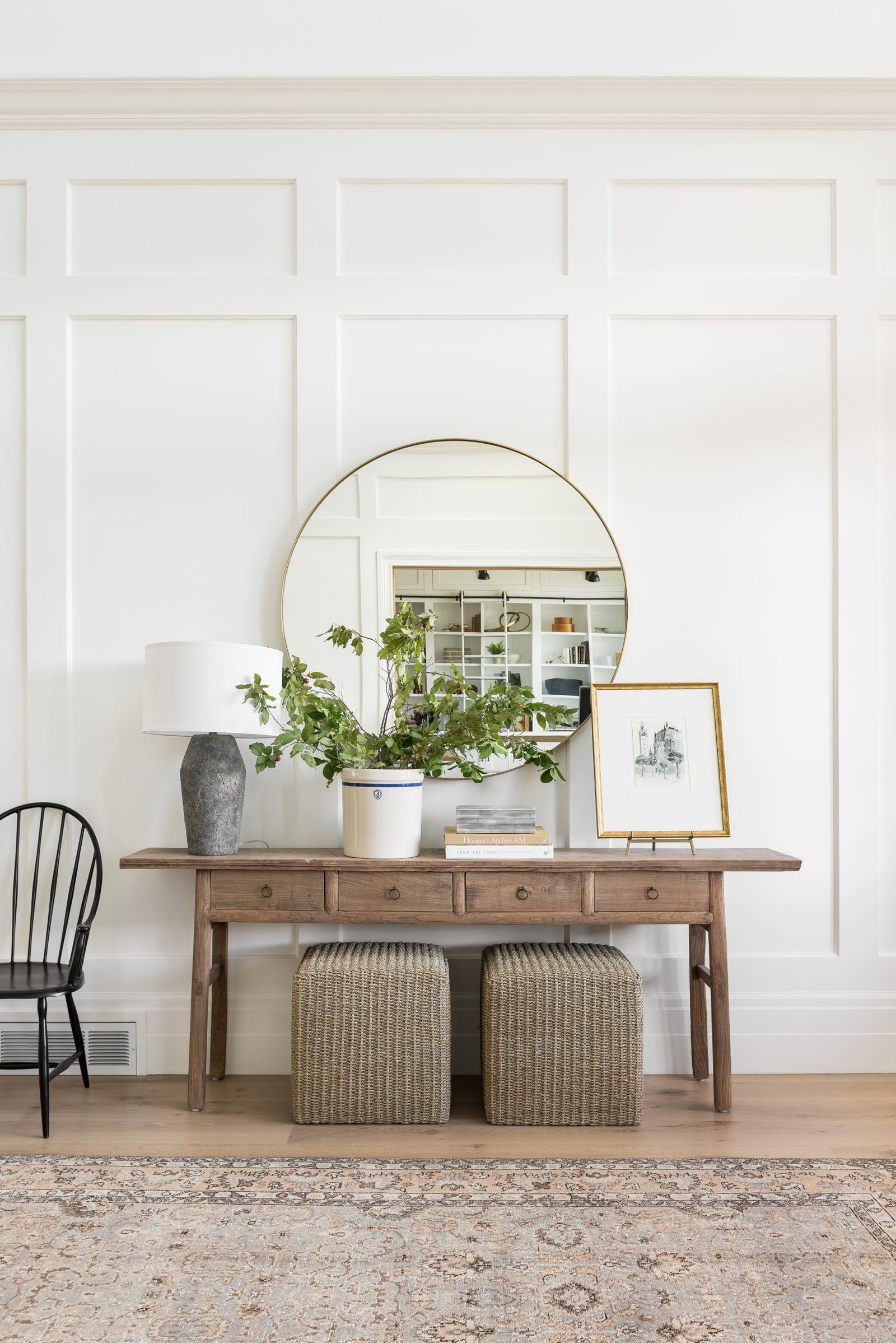
The professional approach is based on three items at three different heights:
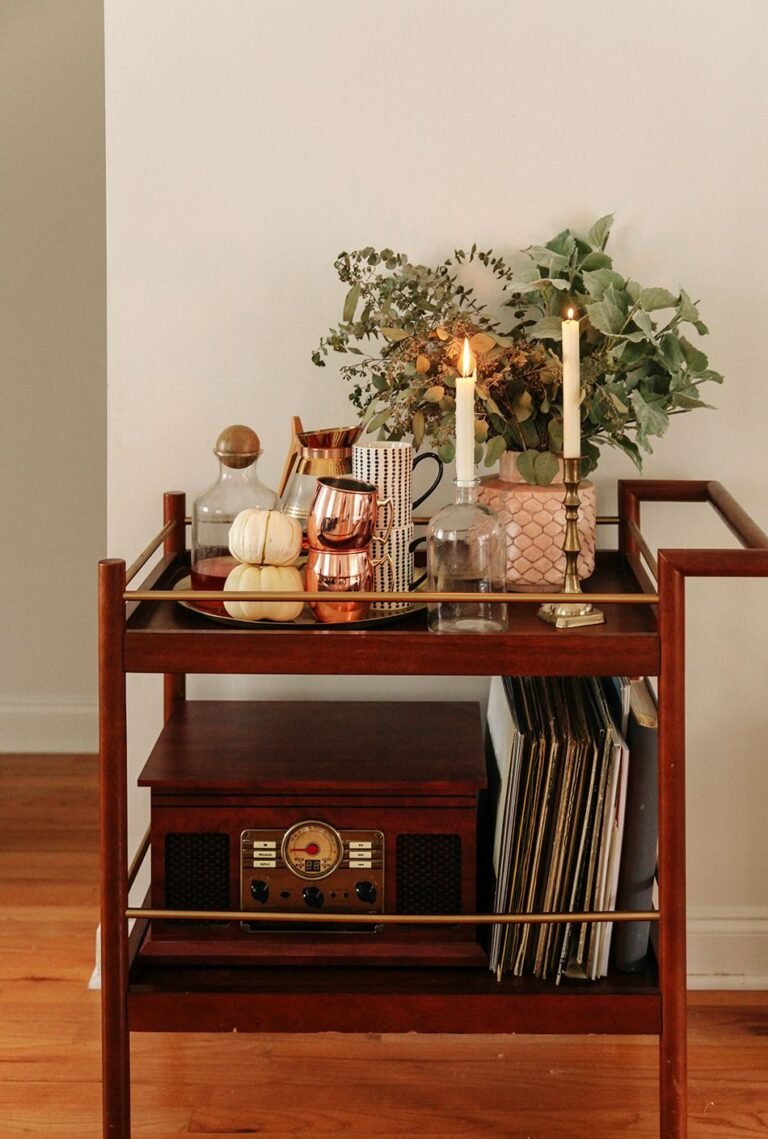
- A tall element: a lamp, a dramatic sculptural vase, or artwork propped against the wall behind
- A medium element: a book stack, a chunky candle, a small sculptural object
- A low element: a shallow tray, a small bowl, a flat decorative item
Arrange in an asymmetrical grouping. Step away. Refine. Repeat.
The principle that elevates the whole: leave significant surface empty between groupings. Crowding every inch is the signature of uncertainty. Curated emptiness is the signature of confidence.
10. The Unusual-Material Console That Gives Your Entry a Signature
Here’s an invitation for those who want their home to be genuinely distinct:
Leave the standard options behind. Walk past the ubiquitous marble. Pass by the familiar reclaimed wood. Find something that belongs exclusively to your sensibility.
Rattan and cane with their warm, resort-like layers. Faux shagreen finishes with their exotic, tactile quality. Resin in jewel tones — deep sapphire, rich emerald — that turns the console into the room’s definitive statement piece.
Reclaimed timber on welded steel legs carries both craft and edge. Poured concrete on blackened iron legs has gallery-level authority in a residential setting.
The objective: a material that communicates something genuinely specific about who you are. Not who design trends say you should be.
The Single Proportion Mistake That Undermines Every Console No Matter How Beautiful
Final guidance before you start shopping — and it matters more than almost anything else.
Height is everything.
Too low and the console reads as an accident. Too high and it drifts into commercial territory, out of place in a residential setting.
The right height range: 28 to 34 inches. For most entries, approximately 30 inches — the height of a standard sofa back — provides the most visually satisfying result.
And hang your wall art correctly. A mirror or framed artwork above the console should have its lower edge positioned 3 to 6 inches above the table surface. Close enough to feel related. Far enough to breathe.
Two details. The difference between a room that looks expensive and one that looks almost expensive.
Your Entryway Already Knows What It Needs to Be
Everything you need to transform your entry is on this page.
You understand now what a great console table actually accomplishes — how it introduces your home before it has said a single word. How it shapes the feeling people carry with them from the moment they step inside.
Here’s the only decision left.
Let another month pass with the wall still waiting. Or choose one idea from this list — just one — and begin building the entry that matches the image you’ve been carrying in your head.
The result that looks like it required a designer and a five-figure budget? It’s just waiting for someone to apply the right principles.
That’s you, as of right now.
Make your entrance matter.
“The right console table is not just furniture — it is the opening line of your home’s story.”