29 Bathroom Mirror Ideas That Finally Fix the Room
Disclosure : This post may contain affiliate links or paid partnerships. I may earn compensation if you click a link or make a purchase, at no additional cost to you. See my disclosure for more info.
Every morning you deal with the same thing.
A bathroom that almost works. Almost looks good. Almost feels like something you’d see on a design blog.
But something’s still off, and you can’t quite name it.
Name it now: it’s the mirror.
The mirror is the most prominent vertical object in most bathrooms. It’s the thing everyone interacts with, the thing everyone sees. It sets the aesthetic tone for the entire wall.
When it’s wrong — or worse, when it’s simply absent of character — it pulls the rest of the room down with it.
When it’s right, everything else looks better for being near it.
Here are 29 specific ideas to get your mirror right — and by extension, your bathroom.
Non-Rectangular Shapes: The Fastest Way to Elevate
Bathrooms are rooms of rectangles. Every tile. Every door. Every towel bar. All right angles.
Put a different shape on the wall and the room wakes up.
Curves in a room of corners create the contrast that makes a space feel curated.
An arched mirror is the single fastest path to an architecturally interesting bathroom that requires zero actual construction. The curve softens the room. It introduces warmth. It makes a plain vanity look intentional.
2. The freeform outline mirror.
Fluid. Irregular. Sculptural by nature.
A mirror without a predictable shape stops being purely functional and starts being an object of interest. In a small bathroom or powder room, this is the element that guests notice immediately and remember later.
A shape with inherent grace. Timeless in the way rectangles aren’t.
Combine with a pedestal sink for a composition that reads as genuinely elegant — the kind of design that appears collected over time rather than assembled in a single afternoon.
Geometric precision without the coldness that minimalism can sometimes carry.
The hexagon brings structure and a modern edge while remaining livable. The right choice when you want contemporary without clinical.
5. The peaked cathedral mirror.
Tall, narrow, pointed or arched at the top. An architectural reference to European church windows.
Its primary function in a bathroom is vertical emphasis — drawing the eye upward, making the ceiling feel higher, making the room feel less confined. Compact bathroom? This is one of the most effective optical tools available.
The Frame: What Gives the Mirror Its Identity
If shape determines what the mirror looks like, the frame determines what it says.
6. The chunky natural wood frame.
Wood is the only material in most bathrooms that reads as genuinely organic. And that’s exactly its value.
In a space dominated by ceramic, glass, and chrome, a thick wood frame introduces warmth and texture that changes the entire room’s temperature. Without it, the space can feel clinical. With it, it feels like a home.
7. The slender black metal frame.
The closest thing to a universal design answer in a mirror frame.
Thin black metal works in virtually every setting — minimal, industrial, farmhouse, transitional, traditional. It has a graphic precision that reads as deliberate regardless of context. Always appropriate. Never cheap-looking.
Gold. Brass. Antique bronze.
A metallic frame has a unique ability: it radiates warmth and catches light in ways that wood and painted frames don’t. It elevates the perceived quality of a mirror — and a room — more efficiently than almost any other frame choice.
The value return per dollar invested is exceptional.
9. The weathered reclaimed-wood frame.
Raw. Rough. Textured. Built to look found, not manufactured.
Character — real, physical, visual character — is rare in modern bathrooms. A reclaimed wood frame provides it. In a room of smooth, pristine surfaces, it’s the friction that makes everything interesting.
The texture choice. Handcrafted, dimensional, visually rich.
Rattan introduces a natural, tactile quality that no other bathroom material can replicate. In a room built from manufactured surfaces, it’s the element that makes the whole space feel layered instead of assembled.
Scale Up: Why Bigger Usually Wins
One rule, near-universally applicable:
A too-small mirror is worse than no mirror at all.
A mirror that doesn’t fill enough of its wall looks lost and apologetic. Appropriate scale — or deliberate overscale — makes the room look planned.
11. The floor-to-ceiling mirror.
In a small bathroom, this is the renovation you don’t need a contractor for.
Ceiling-height reflection doubles perceived depth. Light multiplies. The room opens. If cramped square footage is your frustration, this is the answer that doesn’t involve a building permit.
12. The large-scale round mirror.
Bigger than comfortable. That’s the target.
A wide circular mirror above the vanity creates the room’s primary focal point. It anchors and organizes the space. At scale, the circular form prevents the weight from feeling oppressive.
13. The full-span horizontal mirror.
Edge-to-edge. Unbroken. No joints or gaps.
Above a double vanity, continuous glass creates a seamless, premium-grade effect that individual mirrors can’t replicate. You’ve seen this in high-end hotels. The price to achieve it at home is lower than expected.
Frameless Mirrors: Restraint as a Statement
Not all mirrors need ornament. Sometimes the absence of a frame is the design choice.
14. The clean frameless rectangle.
Glass to wall. Nothing between them.
In minimal or contemporary bathrooms, this mirror disappears into the room — reflecting everything, contributing nothing to clutter. The room feels expanded, clean, and intentionally undecorated.
15. The frameless beveled-edge mirror.
Borderless, but the angled perimeter scatters light in a distinctive way.
That detail separates “this was here when I arrived” from “I chose this specifically.” Same glass, same size — but a completely different result.
16. The freeform frameless mirror.
A sculptural glass silhouette on the wall. No frame, no geometric outline.
The mirror becomes a piece of art. One that also works as a mirror. More personality than any rectangle could supply.
Illuminated Mirrors: Light That Does More Than Illuminate
An LED mirror doesn’t just look different. It changes the quality of your daily routine.
That’s not marketing language. It’s a practical distinction.
17. The ambient LED backlit mirror.
Warm glow from behind the glass. Soft. Flattering. Absolutely nothing like an overhead fixture.
Ceiling lights cast shadows on your face. This eliminates them. You look better. The room feels warmer. The morning starts more gently.
This is the highest-leverage upgrade on this list. If you buy one thing, let it be this.
18. The face-directed front-lit LED mirror.
Light from the mirror’s own surface, aimed directly at you. Even, shadow-free, consistent.
Precision tasks in front of a mirror — makeup, skincare, detailed grooming — become dramatically easier when the light source is the mirror rather than a ceiling fixture above and behind you.
19. The anti-fog heated LED mirror.
You finish a hot shower. You look up. The mirror is clear.
No wipe, no wait, no frustration. A built-in heating element prevents fog before it starts. This feels like a luxury until you realize you use it every single day.
You won’t miss the old mirror. You’ll miss this one when you travel.
20. The color-temperature-tunable LED mirror.
Daylight calibration for mornings. Warm amber for evenings. Adjustable.
Your reflection matches the environment you’re preparing for. No more discovering mid-day that your makeup or outfit reads completely differently than it did under warm bathroom light.
Double Vanity Mirrors: The Three Valid Approaches
Two sinks, two mirrors. Simple in theory. Often mishandled in practice.
21. Identical rounds above both sinks.
Symmetry delivers balance. Two matching circles, evenly placed, create the visual rhythm that makes a double vanity feel resolved. Reliable. Always appropriate.
22. Consistent finish, intentionally different shapes.
Unify through metal finish — matte black, brass, brushed nickel. Vary the silhouettes.
The finish reads as cohesion. The different shapes read as curation. The result: a vanity that looks like it was assembled thoughtfully, not simply matched.
Coordinated is a lower goal than curated.
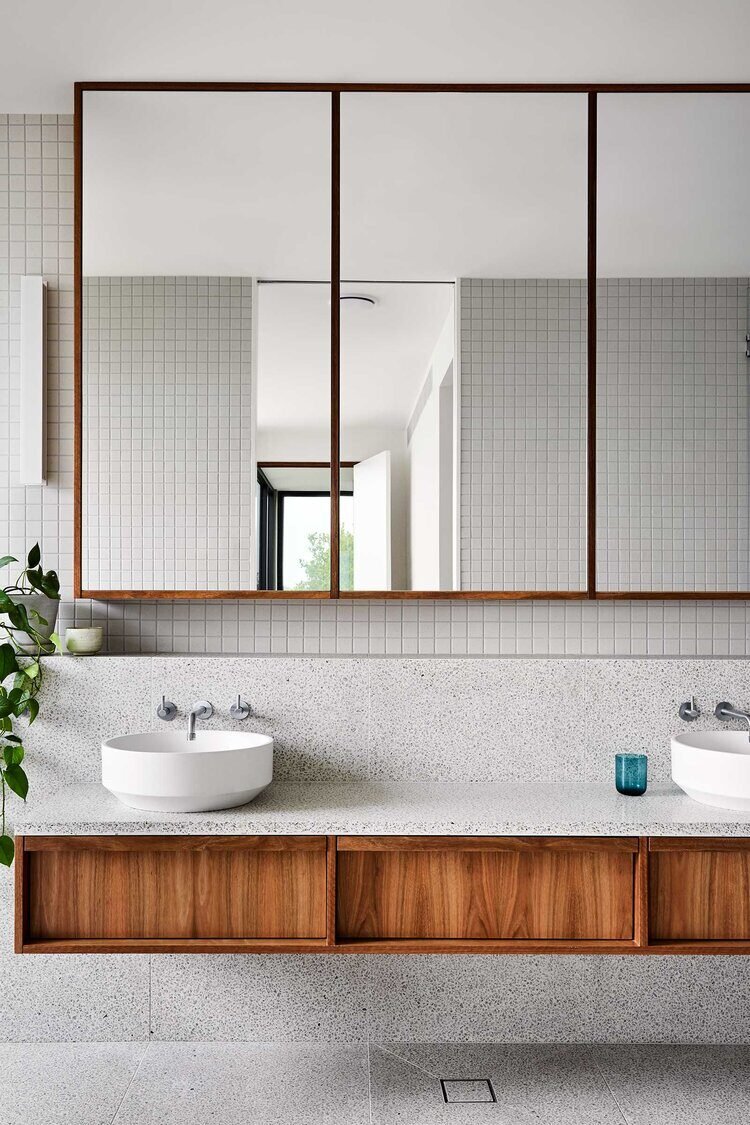
23. One continuous mirror covering both sinks.
Unbroken. Seamless. Single panel across the full width.
Clean, luxurious, spatially expansive. The approach that high-end hotels rely on. Far more affordable to replicate than most people assume.
Placement: Three Ideas Most Bathrooms Never Explore
24. Resting on the counter surface, propped against the wall.
Unstudied. Editorial. The kind of placement that looks deliberately casual.
Museum putty at the base keeps it stable. The overall effect is a bathroom that looks styled without looking arranged.
25. Hung directly above a window.
Over the window, not beside it. The light filters around the mirror’s edges during daylight hours and creates a soft, atmospheric glow. Rare. Consistently beautiful. A detail almost nobody tries.
26. Angled into a bathroom corner.
For tight layouts where flat wall space is scarce, a diagonal placement solves the problem while appearing to be a creative design choice.
Which it is.
Storage Behind the Mirror: The Invisible Organization
Counter clutter is a universal bathroom problem. The best solution isn’t removing things. It’s hiding them behind the mirror.
27. The recessed flush medicine cabinet.
Not your grandparents’ medicine cabinet.
Current versions are wall-flush, frameless or minimally framed, and soft-close. They present as a beautifully chosen mirror. Open them and there’s deep, organized storage behind. Counter clears. Bathroom transforms.
28. The mirror with a built-in lower display shelf.
A narrow ledge beneath the mirror. Enough for a few intentional objects.
A candle, a small plant, a single bottle. The shelf creates a composed moment right at eye level — the kind of quiet detail that makes a whole room feel finished.
The One That Stands Apart
29. A vintage or antique mirror.
The choice that separates attractive bathrooms from memorable ones.
An old mirror placed in a contemporary bathroom creates the generative tension between old and new that makes rooms genuinely interesting. Real patina. Subtly imperfect glass. An ornate frame against clean tile and polished fittings.
It succeeds precisely because it’s incongruous. And because no two vintage mirrors exist in identical form, your bathroom becomes genuinely one of a kind.
The Practical Checklist Before You Buy
Go through these before placing any order:
Not too high. Center point at eye level. Any higher and the vanity relationship breaks down and the whole wall looks poorly proportioned.
Not too small. Measure the vanity first. The mirror should approximate that width, never less than about 60% of it. Smaller reads as forgotten, not chosen.
Consider the light source. Even a perfect mirror is limited by bad lighting. Understand where your light comes from before committing to placement.
Function first. If you can’t see yourself clearly, you have a wall piece. Beautiful, maybe. But a mirror needs to work.
One Decision, One Real Difference
Your bathroom gets the least design attention of almost any room in your home. And yet you’re in it every single day.
One thoughtful mirror swap is often all it takes to close that gap.
No renovation budget. No construction crew. Just one deliberate choice in the spot your eye lands on more than any other.
You have 29 ideas here. One of them is right.
Find it. Order it. Hang it.
And finally walk into a bathroom that feels exactly the way you’ve been wanting it to.
You’ve been settling for too long.