Room for Two: 17 Bunk Bed Ideas for Shared Kids’ Rooms
Disclosure : This post may contain affiliate links or paid partnerships. I may earn compensation if you click a link or make a purchase, at no additional cost to you. See my disclosure for more info.
Sharing a room is hard enough.
Sharing a small room is harder. And sharing a small room that doesn’t have much personality? That’s when the bickering starts in earnest.
The good news is that bunk beds — which feel like a compromise at first — can actually solve most of what makes shared small rooms difficult. They separate sleeping spaces vertically. They free up floor space. And when handled thoughtfully, they give each child a clearly defined territory.
The bad news is that most people stop at “they fit in the room” and wonder why the room still feels chaotic.
These 17 ideas go further. They address the storage problem, the lighting problem, the privacy problem, the “this is MY side” problem, and the “it just doesn’t look like anything” problem. All of them.
The Real Role of Bunk Beds in a Kids’ Room
Here’s the frame shift that changes everything.
Bunk beds are not a furniture concession. They are the room’s organizational center of gravity. Everything else in a small kids’ room should be decided in reference to the bunk bed.
When you treat the bunk as the defining element — rather than the thing you’re trying to design around — the room becomes much easier to resolve.
17 Ideas That Work in Real Kids’ Rooms
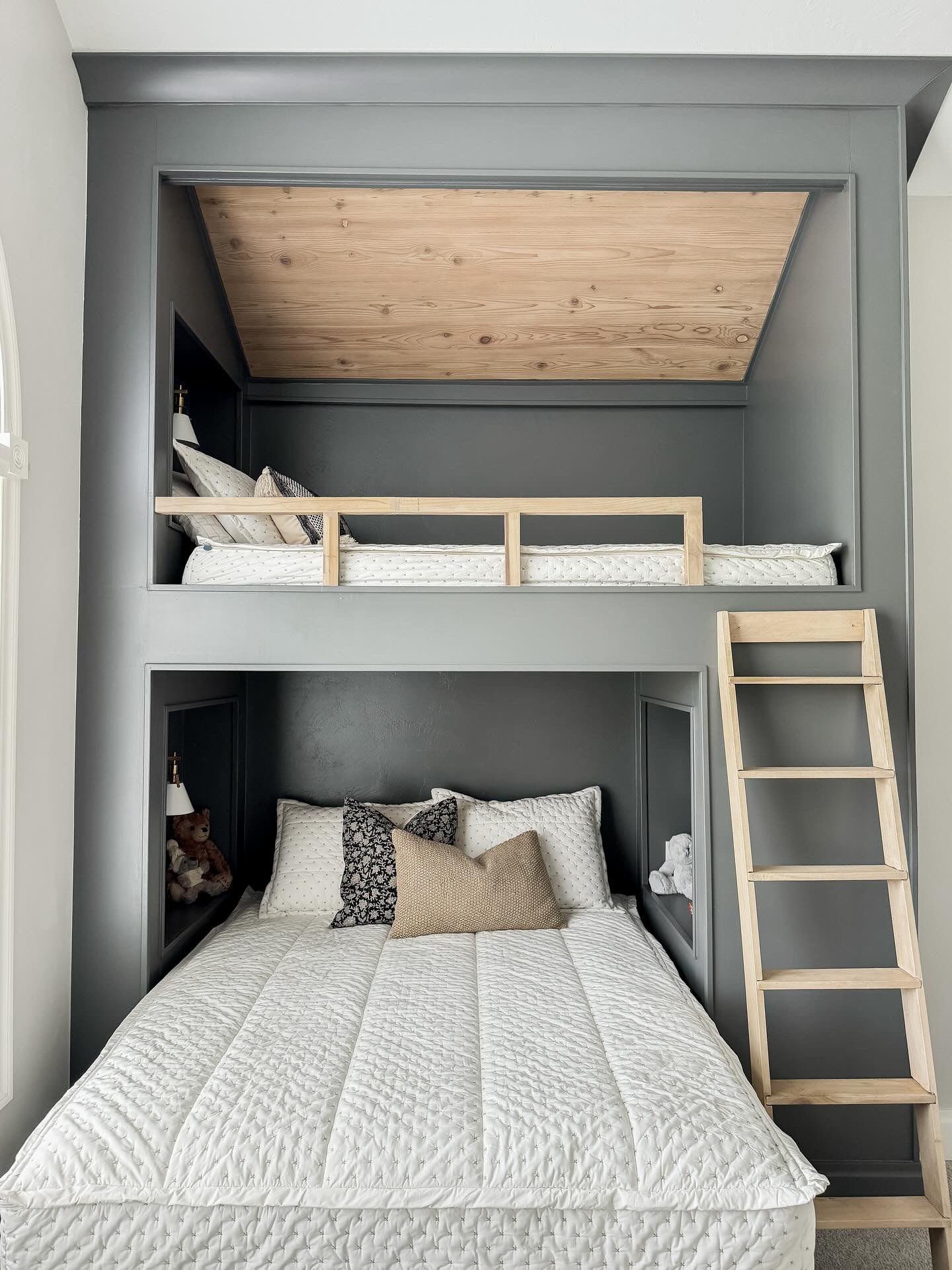
1. A Personal Reading Light for Every Bunk
Install a wall-mounted sconce next to each sleeping level.
This ends one of the most universal bedtime disputes between sharing children: “Turn off the light!” / “I’m still reading!”
When each child controls their own light source, the negotiation disappears. Each bunk becomes a self-managed personal space. That changes the emotional tone of the whole room.
2. Curtains That Create Little Rooms-Within-the-Room
Hang fabric panels from tension rods across the front of each bunk.
Children who have a closeable space of their own — even a small one — tend to protect it with pride. They decorate it. They maintain it. They stop treating the whole room as a shared dumping ground.
From a design perspective, curtained bunks also look far more intentional than open-face bunks. The fabric introduces softness, color, and texture that the frame alone doesn’t provide.
3. A Statement Wall Behind the Beds
Choose a bold wall color and apply it to the wall the bunk sits against.
Kids’ rooms that feel exciting usually have one wall doing something decisive — a deep coral, a bright sage, a rich indigo. The bunk bed in front of it becomes the stage.
This one move transforms the room’s energy faster than almost anything else on this list.
4. Stair Drawers That Solve the Clutter Problem
Replace the standard ladder with a stair unit with storage drawers.
Kids accumulate stuff. That’s not a judgment — it’s physics. Stair drawers give that stuff a home without adding any furniture, without requiring any floor space, and without any organizational system that depends on the child to maintain it.
Everything goes in the drawer. The floor stays clear. Done.
5. Bedding That Makes the Bunks Look Like They Belong Together
Pick bedding sets for both bunks that share a color family while expressing individual personality.
One child likes dinosaurs; the other prefers space. If you find a dino print and a galaxy print that share the same blue-and-green palette, both bunks feel coordinated without erasing individual identity.
The cohesion makes the room feel designed. The individual differences make each child feel seen. Both matter.
6. A Trundle for Sleepovers Without the Chaos
Fit a rolling trundle bed under the lower bunk.
When a friend stays over, it pulls out. When they leave, it disappears. No air mattress inflation at 10 PM. No guest mattress leaning against the wall for six months because there’s nowhere to store it.
Sleepovers become logistically easy. The room stays manageable the rest of the time.
7. Name Signs That Define Each Child’s Territory
Mount a personalized name sign above each bunk.
It sounds simple. In a shared room, it’s strategic.
The name sign says: this bunk is yours. You are responsible for it. It’s also a reflection of you. Children respond to that ownership. They keep the space tidier. They fight over it less. They feel genuinely at home in a room that officially has their name in it.
8. Floating Shelves for Each Child’s Bedtime Essentials
Put a floating shelf at the right height for each bunk.
Current book. Water bottle. Small toy. Photo of a pet or a friend. Whatever that child needs within arm’s reach at night, it lives here.
No nightstand. No floor space consumed. The essentials are accessible, and the room breathes.
9. An L-Configuration for Bigger Kids With More Needs
As children get older, they need space for homework, hobbies, and stuff that isn’t sleeping.
An L-shaped bunk creates a naturally sheltered floor zone under the elevated bunk portion. That zone can hold a desk for the older child, a reading corner, or organized toy storage that doesn’t encroach on the shared floor.
10. Each Child Gets Their Own Interior Wallpaper World
Apply different peel-and-stick wallpaper inside each bunk.
Let each child choose their pattern. Commit to their choice. The result is two very different micro-environments living inside the same bunk structure.
This level of personalization, bounded by the frame, produces remarkable buy-in from children. They take care of spaces they had a hand in designing.
11. Bottom-of-the-Top-Bunk LED Lighting
Stick warm LED tape along the underside of the top bunk.
The child in the lower bunk gets soft, gentle light that doesn’t require a lamp on a shelf. It’s cozy. It helps with reading without disturbing anyone. And at 2 a.m. when someone needs the bathroom, nobody has to turn on the overhead.
12. A Slide That Makes the Bunk the Best Thing About the Room
If you have the floor space, a slide off the top bunk is worth every cubic inch it occupies.
Children who love their room are easier to get to bed and easier to get up in the morning. A slide contributes meaningfully to both outcomes.
Most are designed to be removed when the novelty passes or when the child ages out of it.
13. A Desk Zone Under the Loft for Older Kids
For a child who needs serious study space, a loft bunk with a full desk setup below — including proper task lighting and a corkboard for assignments — creates a dedicated workspace in a room that has no business fitting one.
The sleep-to-work transition happens vertically. The room earns its square footage twice over.
14. A Rope Basket for Each Child’s Bedside Overflow
Clip a small woven basket onto the side rail of each bunk.
Books that didn’t make it to the shelf. A flashlight. A stuffed animal that needs to stay close. The basket catches it all without requiring a surface.
It also makes the bunk look lived-in in the best possible way — inhabited and personal, not just functional.
15. Two-Tone Frames That Reflect Two Different Kids
Let the frame finishes reflect the personalities of the two children using them.
A bright painted upper for one child, a natural wood lower for the other. Or any two-finish combination that each child had some say in.
This degree of personalization within a shared structure does something important: it makes both children feel that the room was designed for them specifically, not just assigned to them.
16. A Canopy for Whoever Gets the Top Bunk This Year
Drape a fabric canopy from ceiling hooks above the top sleeping level.
This turns the top bunk into the universally desired option. The child who gets it this year feels like they won something. The child who doesn’t will lobby for fair rotation.
That’s a manageable problem. A room both children want to sleep in is the real win.
17. A Color Scheme That Holds the Whole Room Together
Even with two very different children and two very different bunk personalities, a three-color palette unifies the room.
Choose three colors that both children can live with. Apply them across the frames, the bedding, the walls, and the accessories. The individual elements can vary; the palette holds it together.
Without this, a shared room feels like a territorial dispute expressed in decor. With it, it feels like a room that belongs to both of them equally.
The Thing That Makes Shared Rooms Fail
You know what it is.
Too much stuff in too little space.
The bunk bed created floor area. Then both children filled that floor area with their individual mountains of stuff, plus a shared dresser, a shared bookcase, and a bean bag that seemed like a good idea and now occupies valuable square footage as a very expensive cat bed.
Protect the floor. Use the bunk’s storage solutions — stair drawers, shelves, the trundle — to handle the storage load. Fight the accumulation impulse. The clear floor is what makes the room work.
The Shared Room That Feels Like Home for Both
This is achievable. Not aspirationally — practically.
A shared kids’ room that both children feel genuine ownership of, that functions well, that looks considered, and that stays manageable over time — it exists. You can build it.
Pick the ideas from this list that match your children’s ages, your room’s layout, and your available budget. You don’t need all 17. You need the ones that directly address your specific problems.
Start there. The room will follow.