20 Designer-Approved Outdoor Jacuzzi Concepts for a Backyard That Looks Intentional
Disclosure : This post may contain affiliate links or paid partnerships. I may earn compensation if you click a link or make a purchase, at no additional cost to you. See my disclosure for more info.
Most backyard hot tub installations share one flaw: they look placed rather than designed.
The tub arrives on a truck. It gets set on a concrete pad or a deck section. The surrounding space remains as it was before, with the addition of one large plastic or acrylic object. The result reads as an afterthought — a thing that was added to a yard rather than a yard that was built around an idea.
The solution isn’t more money. It’s better thinking. And the right thinking starts with one question: what should this space feel like?
Not what should it look like. What should it feel like — at 6 PM on a Tuesday, at midnight on a Friday, in November when the yard is otherwise closed for the season. With string lights on and the water at temperature and everything exactly as it should be.
Answer that question first, and the right design follows directly from it.
These 20 outdoor jacuzzi concepts demonstrate twenty different answers to that question — each one specific, intentional, and executable in a real backyard.
20 Intentionally Designed Outdoor Jacuzzi Concepts
1. Integrated Sunken Design
The design principle behind a sunken hot tub is integration over installation. The goal is for the tub to read as part of the architecture rather than an object placed on top of it.
When the rim sits flush with the surrounding deck material, the eye reads the space as a unified composition. The tub becomes a feature of the yard rather than a feature in the yard. This single distinction separates most amateur outdoor installations from most professional ones.
Access panels are not optional — they’re a design responsibility. Plan them into the elevation drawings before construction begins.
2. Pergola as Spatial Definer
In landscape design, overhead structures do something that ground-level elements cannot: they define vertical space. A pergola over a hot tub creates the psychological impression of a room, not just an area.
The practical applications follow from that: drapes on the sides for adjustable privacy, lighting hung from the beams for atmosphere, climbing plants trained across the roof for seasonal texture.
Cedar or redwood pergolas are the material of choice for designers working in temperate climates. The natural weathering process — the silver-grey patina that develops over three to five years — gives them an aged quality that money cannot buy quickly.
3. Material Hierarchy: Natural Stone
Design quality is established through material quality. The surround of a hot tub is a large surface area with high visual impact — the material choice here shapes the entire aesthetic register of the space.
Natural stone — slate, travertine, quartzite — communicates permanence and geological weight. It ages well, handles weathering gracefully, and never looks dated. It is among the few material categories in outdoor design where “expensive” and “correct” are reliably the same answer.
Specify irregular edge cuts. Uniform cut stone reads as manufactured. Irregular edges read as natural and correct.
4. Wabi-Sabi Soaking Philosophy
The wabi-sabi design principle — finding beauty in imperfection, transience, and incompleteness — translates directly into compelling outdoor spaces.
A cedar soaking tub on raked gravel. bamboo fencing as a simple, honest perimeter. One carefully pruned specimen plant whose form is studied and deliberate rather than ornamental. No decoration. No layering. Just the elements themselves, allowed to be what they are.
The challenge for most homeowners: trusting the emptiness. The space between elements is doing design work. Resist the impulse to fill it.
5. Elevated Platform for Spatial Drama
Elevation is one of the most underused tools in residential landscape design. Moving a hot tub to a second story or rooftop platform introduces a spatial drama that ground-level installations fundamentally cannot achieve.
The view from an elevated position changes the relationship between the occupant and the surrounding landscape. The yard becomes something you look down on rather than something you’re embedded in. That perceptual shift is powerful and immediate.
Structural engineering is mandatory before planning proceeds. Load capacity must be confirmed for the specific weight of the filled installation with occupants — typically between 3,000 and 4,500 pounds.
6. Landform Integration
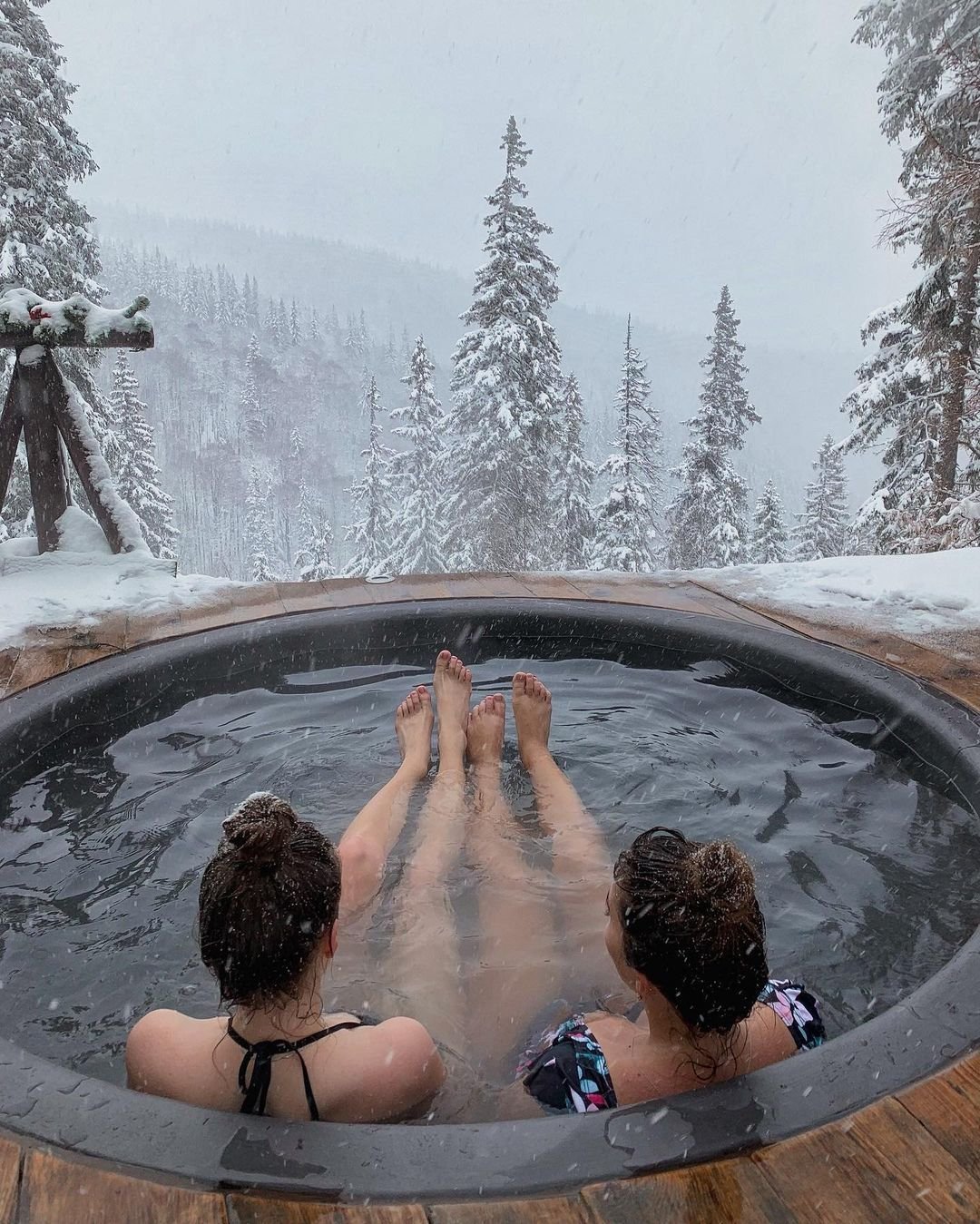
The highest-quality outdoor spaces are the ones that appear to have grown from their sites rather than been placed on them. Hillside integration achieves this more convincingly than almost any other installation method.
The hot tub is carved into the grade. Retaining walls in stone or timber frame it on two or three sides. The grade rises naturally behind. The overall impression is geological — this was here, and someone discovered it.
The thermal benefit is a practical bonus: the earth mass surrounding the installation reduces heat loss significantly, lowering operating costs over the life of the setup.
7. Elemental Contrast: Fire and Water
Classical design often pairs contrasting elements to create tension and resolution. The fire-and-water combination in outdoor design is among the most compelling applications of this principle.
A fire pit positioned within ten feet of the hot tub creates a spatial dialogue between the two elements. The contrast — heat from fire, heat from water, cool air between them — engages the senses simultaneously in a way that a single-element space cannot.
A gas fire pit provides reliable output for consistent use. Wood-burning adds the additional sensory dimensions of smoke, crackling, and the slow theatrical quality of a living fire. Both are correct. The choice depends on whether you prioritize performance or atmosphere.
8. Horizon Line Design
The infinity-edge principle in pool design is borrowed directly from landscape architecture: the visual removal of the boundary between a designed space and the natural environment beyond it.
An infinity-edge jacuzzi on a property with a view extends this principle to a domestic scale. The water appears to merge with the landscape at the horizon. The boundary between the designed space and the natural world is dissolved.
This is a technically demanding installation with cost implications. On a property with a genuine view, it is also the installation that most completely justifies those costs.
9. Biophilic Privacy Screening
Biophilic design — the incorporation of living systems into the built environment — has measurable effects on occupant wellbeing. vertical garden panels applied as privacy screens around a hot tub bring plant life into immediate proximity with the soaking experience.
The practical result: a privacy screen that improves with age, reduces ambient sound through plant mass, and creates the filtered-light quality of a natural clearing rather than the visual hardness of a solid fence.
From a design perspective, the living wall also introduces seasonal variation — the space looks different in spring than in summer, in summer than in fall. That temporal dimension makes the space feel alive rather than static.
10. Programmatic Swim Spa Solution
Design programs — the list of activities a space must support — determine form. When the program includes both active aquatic use and passive soaking, a swim spa is the correct formal response.
One unit. Two zones. One clear design decision that eliminates the space-planning complexity of separate pool and spa installations.
The year-round operational capability of a swim spa is also a design advantage: the space remains programmatically active in winter rather than becoming a covered object waiting for seasonal reopening.
11. Total Theme Commitment
In design, coherence is a higher value than any single element. A space with a clear, consistently applied concept — even a bold or unusual one — reads as more sophisticated than a space with many individually interesting elements that don’t relate to each other.
Tiki torches. Lava rock. Palms. Thatch. When every element reinforces the same concept, the result is conviction. Conviction is what separates an impressive outdoor space from a merely nice one.
An outdoor shower with a rainfall head supports the concept and adds a functional ritual element to the soaking sequence.
12. Minimalism as Design Language
Minimalist design is not the absence of design — it’s the reduction of design to its essential moves. Every element in a minimalist composition must be load-bearing.
Poured concrete surround. Horizontal line of the rim. Color-changing LED lights beneath the rim, directed downward, producing a glowing waterline at night. Those three moves, done correctly, are sufficient.
The downlit LED technique is particularly effective because it creates apparent mass and float simultaneously — the tub appears to hover above its own shadow at night. It is a simple trick with a dramatic result.
13. Found Space: The Clearing
The most compelling outdoor rooms are ones that feel discovered rather than constructed. The forest clearing archetype — a sheltered space open to the sky, surrounded by vertical elements on all sides — is one of the most powerful spatial experiences available in landscape design.
Dense ornamental grasses, multi-stem birches, or columnar arborvitae around the hot tub perimeter create the vertical enclosure. A decomposed granite path leading into the space creates the discovery sequence. The space reveals itself gradually — and that spatial narrative is part of the design.
14. Spatial Hierarchy Through Levels
Level changes are one of the primary tools landscape architects use to create spatial hierarchy — the differentiation of spaces by importance and function.
A tiered deck assigns spatial hierarchy explicitly: gathering and dining above, transition and seating in the middle, soaking below. The lowest level is the most sheltered, the most private, the most special.
The material choice for the deck surface encodes the design values: composite for longevity and low maintenance, hardwood ipe or teak for warmth and tactile quality. Neither is wrong. They serve different design intentions.
15. The Hortus Conclusus
The hortus conclusus — the enclosed garden — is one of the oldest garden archetypes in Western design history. The U- or L-shaped house creates its geometry naturally.
The existing walls are the enclosure. oversized planters establish the corners with mass and vertical interest. outdoor curtains provide adjustable screening on the open side. candle lanterns at grade level provide the intimate warm light that makes enclosed garden spaces feel genuinely private.
The hortus conclusus is a design solution with a two-thousand-year track record. There is a reason it keeps appearing in the best residential gardens.
16. Tactile-Rich Eclectic Setting
In contrast to minimalism, maximalist or eclectic design assembles meaning through accumulation — each element adding a layer of reference, texture, and personal history.
Macramé wall hangings introducing handcraft. Patterned tile introducing global reference. outdoor rugs introducing warmth and comfort. wooden bench introducing seating and human scale. Each element contributes to a composition that reads as collected rather than specified.
The discipline: every element must be outdoor-rated. The aesthetic freedom of eclectic design lives and dies on material performance. Sealed wood, UV-stable textiles, and mold-resistant materials are the structural requirements that make the aesthetic freedom possible.
17. Pavilion as Year-Round Room
In traditional landscape architecture, the pavilion is a structure that extends the usability of a garden space into conditions that would otherwise exclude it — rain, cold, heat. A hardtop gazebo is a contemporary residential pavilion.
It creates a covered outdoor room whose program includes soaking in all weather conditions. The transition from seasonal amenity to year-round room changes the spatial and experiential quality of the entire yard — the hot tub area becomes a permanent feature rather than a summer installation.
18. Water Feature as Acoustic Element
Sound design is an underconsidered dimension of outdoor space design. The continuous movement of water from a raised spillover spa into the pool below creates a sound layer that fundamentally changes the ambient quality of the outdoor environment.
The acoustic masking effect of moving water reduces the perceived presence of traffic, neighbors, and other ambient noise. The resulting quiet is a designed quality — created by introducing a sound rather than eliminating all sounds.
19. The Reductive Statement
Some of the most powerful design moves are subtractive. The reductive statement — a single high-quality object in an uncluttered setting — communicates confidence and clarity that layered, complex installations often lack.
A premium freestanding jacuzzi on a level gravel pad. One specimen plant. One towel hook. Clean gravel perimeter. Nothing competing with the primary object.
The quality of the tub itself carries the space. This approach requires choosing the right tub — the design can’t compensate for a product that isn’t worth looking at.
20. Smart Systems as Invisible Infrastructure
Good design is invisible. The best-designed systems work so seamlessly that you never think about them — only about the experience they enable.
An app-connected hot tub is, from a design perspective, a piece of invisible infrastructure. The temperature is always right. The lighting always appropriate. The filtration handled without intervention.
The designed result: a space that is always ready — that never requires you to manage it before you can enjoy it. That operational seamlessness is as much a design quality as the material choices and the spatial composition.
The Non-Negotiable Technical Foundation
Every one of the designs above requires the same functional infrastructure. These are not aesthetic considerations — they are technical requirements:
Drainage design. Every element of the hot tub area must slope toward a designated drainage point. Standing water is both a safety hazard and a design failure. Drainage must be specified before construction, not addressed after.
Equipment access. No design that prevents future equipment access is a complete design. Access panels on at least one side of every built-in installation are a requirement, not an option.
Correct electrical specification. Hot tubs require 220–240V GFCI-protected circuits, installed by electricians with specific experience in this application. Under-specification here is both dangerous and non-compliant with code.
Structural foundation. A loaded hot tub is heavy — between 3,000 and 4,500 pounds depending on size and occupancy. The foundation must be engineered for that specific load: reinforced concrete, rated compacted base, or a structurally designed deck.
These technical requirements are the unseen structure on which all visible design quality depends.
The Design Decision Is Yours
Twenty concepts. Twenty different answers to the question of what your backyard should feel like.
Design begins with clarity about that question. What experience are you building toward? What should it feel like at 9 PM on a weeknight, alone, after a difficult day?
The answer to that question is in the list somewhere. Find it. Make the decision.
The technical execution follows from the decision. The decision is what most people put off indefinitely.
Your yard is ready for this. Are you?