Cool Plunge Pool Designs Your Backyard Has Been Waiting For
Disclosure : This post may contain affiliate links or paid partnerships. I may earn compensation if you click a link or make a purchase, at no additional cost to you. See my disclosure for more info.
You know that patch of your yard that just kind of… exists?
No purpose. No plan. Just a stretch of grass or bare dirt that you walk past every day and vaguely feel guilty about.
A plunge pool has probably crossed your mind. A quick cool dip after work. Somewhere to actually spend time outside. A yard you’d actually want to invite people into.
And then the usual suspects arrive. Cost. Disruption. The whole thing feeling bigger and scarier than you want to deal with.
But here’s the honest truth: a plunge pool is a different beast entirely from a full-sized swimming pool. It’s smaller, smarter, and a lot more realistic than most people give it credit for.
Let’s look at nine designs that actually work, and a few things worth knowing before you start making calls.
So What Even Is a Plunge Pool?
Good starting point.
A plunge pool is compact and deeper than your average backyard swimming pool. Built for soaking and cooling off, not for doing laps. Think of it as the pool equivalent of a really good armchair — designed for one specific purpose and excellent at it.
Most fall somewhere between 6 and 15 feet long. That means they fit in lots that would never accommodate a full pool.
Less water to heat, easier to maintain, and faster to build. Three genuinely good reasons to take this seriously.
1. The Natural Stone Plunge Pool
Not everyone wants sleek and modern. Some yards call for something warmer, more natural, more… found.
A plunge pool built with natural stone — flagstone, travertine, limestone — has that feel. Like it was always there. Like the yard grew around it rather than having it installed into it.
Irregular edges. Earthy tones. Maybe some moss or low plants threading through. It’s the kind of thing that looks better after a few summers, not worse.
This style fits perfectly in cottage gardens, Mediterranean-style yards, and rural properties. In a setting like that, a polished concrete pool would look completely wrong. This doesn’t.
Practical bonus: stone stays cooler underfoot in direct sunlight than dark tile or concrete. Worth knowing on a scorching day.
Place landscaping rocks in warm tones around the perimeter, add vertical garden panels along the fence, and put a pair of chaise lounges on the stone surround for lounging after a dip.
2. The Plunge Pool With a Built-In Sitting Ledge
Here’s a lesson learned the hard way by a lot of people:
A plunge pool without somewhere to actually sit inside it feels surprisingly awkward. You step in, and then… what? You stand there. You half-crouch. The whole thing doesn’t quite land.
An underwater bench along one or two walls fixes this completely. Suddenly you have a proper spot. Water at chest level. Somewhere to relax instead of just standing and waiting to feel relaxed.
Go for an L-shape and you’ve basically built a poolside conversation zone. Which sounds fancy but is genuinely just comfortable seating inside a pool.
It costs a lot less than most people expect to add during construction, and it makes more difference than almost anything else.
Pair it with an in-pool stool at the water’s edge, a striped indoor/outdoor rug to define the deck space, and a couple of patio side tables for drinks.
3. The Freeform Plunge Pool With Lush Tropical Plants
This is the one that makes people forget they’re in their own backyard.
A curved, organic pool shape. Palms. Birds of paradise. Oversized tropical leaves. A few boulders scattered around for texture. The whole thing pressing in around you.
Open the back door and you’re somewhere else. Not in the yard you spend every weekend mowing. Somewhere that requires no imagination to enjoy.
Curved shapes also help smaller yards feel bigger — organic lines trick your eye into reading more space than straight edges allow. Genuinely useful when you’re not working with much room.
If your home has any kind of coastal or tropical character already, this will look like it was always supposed to be there.
Frame it with tall areca palm trees, a cedar vertical garden panel along the fence, and outdoor globe string lights above. Evening atmosphere sorted.
4. The Raised Concrete Plunge Pool
Sloped yard? Most people see that as a reason they can’t have a pool. This design sees it as a non-issue.
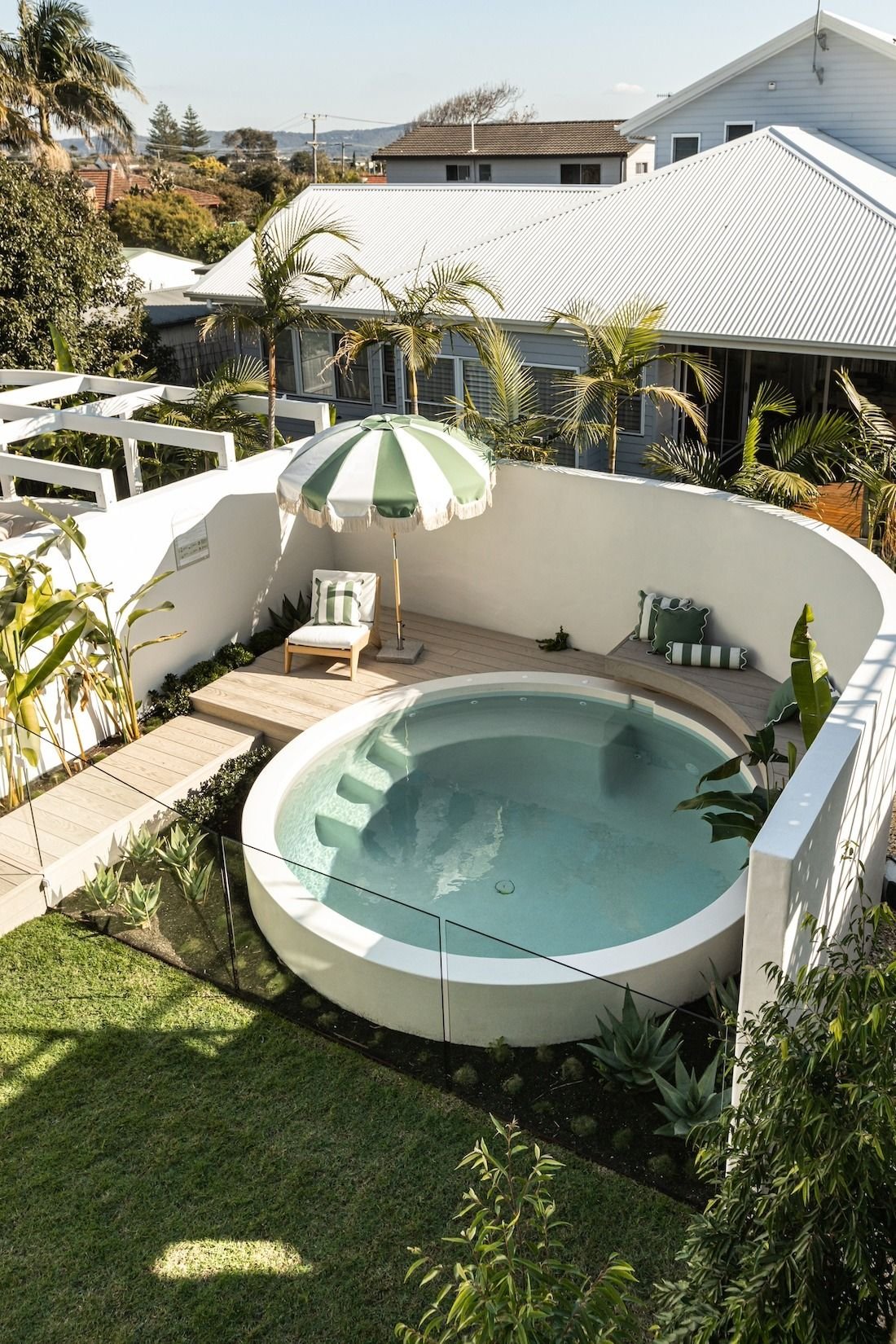
A raised concrete plunge pool sits above ground level instead of going deep into it. The look is clean and modern — surprisingly architectural for something that’s solving a practical problem.
Clad the outside in stone, timber, or render and it fits right in with whatever surrounds it.
The bonus that nobody talks about enough: those raised walls become natural seating. Guests perch on the edge. Kids sit with their feet dangling in the water. You rest your drink on the ledge while you soak. It’s remarkably functional.
Cost tip: if your ground slopes away from the house, a raised build can actually be cheaper because you skip the heavy excavation work that drives up in-ground builds.
Add a louvered aluminum pergola next to it for shade and structure, and use an indoor/outdoor area rug to anchor the seating area.
5. The Plunge Pool Woven Into a Deck
This is the layout that gets screenshotted and pinned and bookmarked constantly. For good reason.
The pool sits inside the deck so everything reads as one continuous surface. Step off the deck, step into the pool. No step down. No awkward edge. Just wood, then water, at exactly the same level.
The deck does triple duty as lounge area, dining space, and pool surround simultaneously. And it makes even a modest-sized yard feel considerably more spacious. That’s not a visual trick — it’s a genuine spatial shift.
Important heads-up though: the decking right at the water’s edge needs to be slip-resistant. Smooth composite boards plus wet feet is a combination that ends badly. This is a safety spec, not an aesthetic preference. Take it seriously.
Teak pool chaise lounges on the deck and a shade sail overhead. A concrete-look outdoor side table between the loungers. Done well, this is the backyard everyone wants to be in.
6. The Cocktail Plunge Pool Fitted With Jets
What if your plunge pool could be two completely different things depending on the season?
That’s the cocktail pool pitch. Sometimes called a “spool” — half spa, half pool — it pairs the compact size of a plunge pool with hydrotherapy jets and temperature control. Some even have a warmer dedicated zone at one end.
Summer: refreshingly cool. Winter: therapeutically warm. One pool, two modes, all year.
If you live somewhere with proper cold winters and you’ve ever watched a conventional pool sit covered and useless for half the year, this is the version that fixes that.
At 10 to 12 feet long, it fits comfortably in most yards without taking over.
Set up a large cantilever umbrella for sun protection, keep reclining chaise lounges nearby, and hang outdoor string lights above for good-weather evenings that stretch naturally into night.
7. The Glass-Paneled Plunge Pool
This one is legitimately show-stopping and there’s no more diplomatic way to say it.
One or more clear acrylic panels in the pool wall let you see the water from outside. You can watch it from the seating area. At night, with underwater LED lighting inside the pool, the effect is wild in the best possible sense.
It works best when the pool is raised or semi-raised, with the glass face toward wherever people naturally gather.
Is it more expensive? Yes. Does it require engineering-grade acrylic and some serious structural thought? Also yes. Nobody should understate that.
But if you want to be that house — the one visitors talk about for weeks after — this is the design that does it.
8. The Japanese-Inspired Deep Soaking Pool
Simple is hard to pull off. This design makes it look easy.
A clean rectangle. Dark stone or tile. Maybe a single bamboo spout sending a quiet stream across still water. Nothing more, nothing extra.
Japanese soaking pools have been perfected over centuries on the principle that depth matters more than footprint. You can sit shoulder-deep in a pool that’s barely 7 feet across. That’s the whole idea.
Surround it with raked pebbles, a few ornamental grasses, and a simple timber screen. Leave some space between things. Let the calm settle in.
This doesn’t feel like a backyard pool. It feels like somewhere you specifically went to decompress.
Useful detail: dark tile soaks up solar heat. In warmer climates, that means your heating system does less work and your energy bill reflects it. Worth factoring into material choices.
9. The Courtyard Plunge Pool
Got a narrow side passage or a walled courtyard that literally does nothing? Don’t give up on it yet.
A slim rectangular pool — maybe 5 feet wide and 12 feet long — in one of those forgotten spaces can become the most-used spot in the entire property. Genuinely.
Put up a vertical garden on the fence wall. String some warm lights overhead. Add two loungers alongside.
The dead zone becomes a destination. It happens every time.
This layout is great for terrace houses and townhouses where a standard pool footprint just isn’t realistic. The limitation pushes you toward something more creative — and usually better — than what you’d have done with unlimited space.
Things That Go Wrong (And How to Avoid Them)
A few lessons from projects that didn’t go smoothly.
Skipping permits. It’s tempting to assume that a plunge pool is too small to need council approval. In almost every jurisdiction, that assumption is wrong. Any permanent in-ground water structure needs a building permit. Skip it and you risk fines, forced removal, and real headaches if you ever sell. Make the call to your local authority before you do anything else.
Ignoring drainage. Bodies entering a plunge pool displace water. Without proper overflow design and site grading, that water goes somewhere it shouldn’t — usually toward your foundation or your neighbor’s fence. Sort drainage in the design phase, not after.
Cutting corners on filtration. Less water volume means chemistry changes faster. A cheap or undersized filter creates recurring water quality problems that are expensive and annoying to deal with. Get the right filtration and sanitation system for your pool’s actual size. You’ll use the pool more when the water is consistently clear.
Forgetting shade. A plunge pool in full sun all afternoon gets warm. When the air temperature is already brutal and the water isn’t noticeably cooler, the whole point of the pool disappears. A shade sail, pergola, or large umbrella makes more difference than people realize. Plan for it from the start.
How to Pick the Right Design
Three questions, answered honestly, and the choice becomes pretty clear.
Space: How much have you actually got? Measure it. Don’t guess.
Use: What will you actually do with the pool? Quick daily cool-offs? Weekend entertaining? Therapeutic soaking through winter? The honest answer rules out several options and makes the right ones obvious.
Style: What does your home and garden already look like? The right pool design will feel like it belongs. A glass-walled contemporary pool next to a traditional farmhouse will always look slightly wrong, no matter how good the build quality is.
Answer all three honestly and the best option tends to announce itself.
Your Backyard Has Been Patient Enough
Think about how much time you actually spend at home. More than you realize, probably.
And yet most people’s outdoor spaces just kind of sit there. Not quite finished. Not really used. A vague plan that keeps getting pushed to later.
A plunge pool changes how you actually live at home.
It gives you somewhere to be outside that isn’t just walking to the bins. It gives guests a reason to stay longer. It makes the property feel like something worth investing in — because it is.
You don’t need a huge yard. You don’t need an elite builder. You don’t need to spend more than makes sense.
You need a clear plan, a design that actually fits your situation, and the decision to stop thinking about it and start doing something about it.
Your backyard is ready. Are you?