Handcraft Your Display: 21 DIY Plant Stand Designs for a Beautifully Styled Indoor Garden
Disclosure : This post may contain affiliate links or paid partnerships. I may earn compensation if you click a link or make a purchase, at no additional cost to you. See my disclosure for more info.
The plant collection is sorted. The plants are healthy and thriving.
What’s not sorted is how they’re displayed.
Grouped on the floor against the wall, fighting for status with the baseboard. Or crowded onto the windowsill in no particular arrangement. Or balanced on the first surface that happened to be available — a stack of books, an upturned box, a folded blanket.
These aren’t displays. They’re plant storage solutions.
And there’s a meaningful difference between those two things.
A good plant display uses height, layering, and visual weight to make greenery feel like a considered part of the room rather than something that got moved around until it fit somewhere. It draws the eye intentionally. It creates a relationship between the plant and the space around it.
Plant stands are the most direct tool for achieving this.
Retail options exist, but they tend toward two problems: either they’re generic to the point of visual blandness, or they’re priced in a way that reflects the current demand for anything plant-adjacent rather than the actual material and craft involved.
The DIY alternative is often superior on both counts. Handmade stands have character. They can be sized exactly right. They can be finished in any color or material that complements your specific space.
Here are twenty-one options — organized by approach — to help you find the right one for your room, your skill level, and your plants.
1. The Salvaged Stool Riser
Secondhand markets and thrift stores regularly stock small wooden stools at prices that make sense for what they are: a sturdy platform at a useful height.
Light sanding to clean up any rough areas, a coat of paint in a finish that suits your space, and a secondhand stool becomes a plant riser with visual weight and history.
The design principle at work here is visual authenticity. Objects with evident history — slight imperfections, worn edges, layers of old paint showing at corners — communicate a sense of time and place that new objects simply cannot. That quality is genuinely valuable in interior spaces that aim to feel lived-in rather than staged.
2. The Copper Pipe Tripod Platform
Copper pipe elbows and short pipe lengths from any plumbing supply form a tripod base that, when topped with a round wood disc, produces a plant stand that works across industrial, bohemian, and mid-century interior styles.
The appeal of copper in interior contexts is its warmth — it introduces a reddish-amber tone that reads as both warm and refined. Against green foliage, copper activates a complementary color relationship that makes each material appear richer and more saturated than it would in isolation.
Assembly requires no special tools. Total build time is approximately fifteen to twenty minutes.
3. The Hairpin Leg Platform Stand
The hairpin leg is a design element that has remained continuously relevant since its mid-century origins because the design problem it solves — providing sturdy support with minimum visual mass — is a genuine and recurring one.
A set of four hairpin legs paired with a round wood top creates a plant stand with legitimate design credentials for a fraction of the retail price of equivalent commercial products.
Wood species and stain choices allow for considerable customization: blonde maple with brass legs reads as Scandinavian; walnut-stained oak with black legs reads as contemporary.
4. The Vertical Crate Display System
Stacking wooden crates vertically with alternating open faces creates a display system that addresses one of the persistent challenges in plant styling: achieving depth variation.
Flat shelving presents all plants at the same depth from the wall. The alternating crate configuration creates multiple planes — some plants closer to the viewer, some further — which creates genuine spatial depth rather than a flat plane of greenery.
Finish options range from unified painted color for a contemporary result to raw or lightly oiled wood for a natural, craft aesthetic.
5. The Knotted Cord Plant Suspension
Macramé plant hangers address a specific and practical display challenge: providing a plant position that is elevated without occupying any floor or shelf surface.
A basic four-cord square-knot hanger takes sixty to ninety minutes for a beginner to complete, requires no tools, and results in a piece that introduces handmade textile texture into interior spaces where hard surfaces otherwise dominate.
From a height and layering perspective, suspended plants also enable display positions that no floor or shelf-mounted stand can provide — mid-wall, near-ceiling, or suspended in front of a window.
6. The Concrete Block Plant Riser
The cinder block plant stand is a direct application of the design principle of juxtaposition — placing materials with strongly contrasting qualities in deliberate proximity to create visual tension.
Industrial concrete: structural, heavy, angular, rough-textured. Living plant: organic, light, irregular, soft-textured.
The contrast between these qualities is exactly the contrast that drives the visual interest. A coat of matte paint unifies the color and removes the utilitarian quality, leaving the textural and structural characteristics to do their intended work.
The result is a display element that demonstrates design awareness, at a material cost of approximately two dollars.
7. The Vertical Ladder Display
A ladder plant stand — whether salvaged or purpose-built — provides a graduated height display structure that efficiently uses vertical space.
Each rung offers a display position at a different height. When plants of varying sizes are placed across the rungs, the result is a visual rhythm — alternating plant mass and open space — that keeps the eye moving upward and creates the sense of a larger, more considered display than a flat shelf could produce.
A simple ladder can be built from two boards and wooden dowels in an afternoon with no specialized tools.
8. The Inverted Wire Frame Stand
Inverting a wire tomato cage repositions a utilitarian garden object into an unexpected structural form.
With the wide ring now forming the base and the narrower ring supporting the pot at the top, the open wire frame between creates visual permeability — the display element is present and visible but doesn’t block the view.
A uniform coat of spray paint removes the garden-supply context, allowing the sculptural wire geometry to read as an intentional design choice. Matte black, bronze, and antique gold all work particularly well against terracotta or ceramic pots.
9. The Fiber-Wrapped Repurposed Container
The principle behind this technique is surface transformation: changing how an existing material reads by introducing a new surface treatment.
Wrapping a tin can in natural jute fiber, secured with adhesive, completely alters the visual character of the container. The industrial tin becomes a warm, textural, handcrafted vessel that reads as an intentional material choice rather than a utilitarian container.
Grouping several in different sizes creates a display with internal scale variation — itself an effective interior styling technique that adds visual complexity without visual clutter.
10. The Feature Wall Shelf Display
Displaying a single plant on a dedicated floating wall shelf with nothing adjacent to it applies the design principle of isolation as emphasis.
Negative space — the empty wall surrounding the plant — functions actively in the composition. It prevents visual competition and directs full viewer attention to the plant itself.
This technique is most effective in rooms that tend toward visual busyness, where the simplicity of a single isolated plant provides meaningful visual relief, and in rooms that feel sparse, where a deliberately placed plant-as-object adds a point of visual interest without contributing clutter.
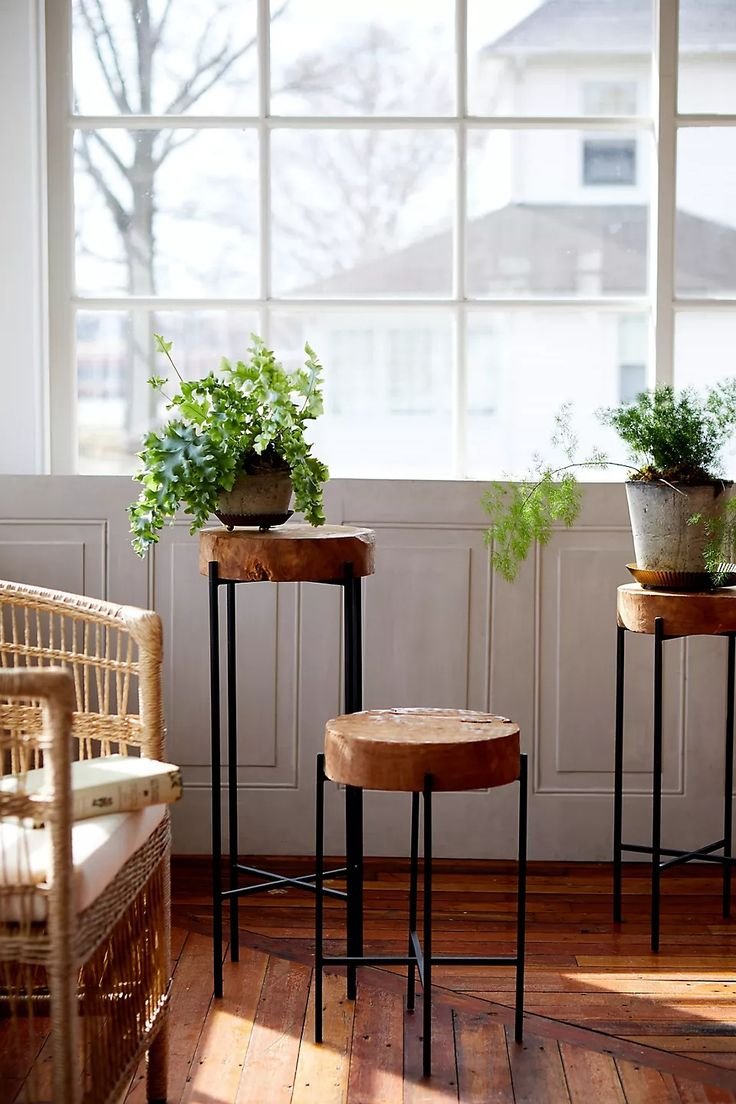
11. The Live-Edge Cross-Section Stand
A cross-section of tree trunk is one of the few genuinely irreproducible plant stand options — the grain pattern, diameter, bark character, and ring count create a completely unique object with each cut.
Finishing the top face smooth while retaining the natural bark perimeter maintains the connection to the material’s origin. A clear polyurethane sealant protects the top from water damage while preserving the wood’s natural color.
This stand works best as a feature piece — under a substantial plant like a monstera, fiddle leaf, or large snake plant — where its scale and organic character are properly complemented.
12. The Reconfigurable Pegboard Wall System
The pegboard display system addresses a specific structural problem in plant collection display: collections grow and change, but fixed shelving cannot.
A pegboard installation allows complete repositioning of hooks and shelves without new holes or structural commitment. Pots can be moved, heights adjusted, and entirely new configurations established as the collection evolves.
This is a long-term investment in display infrastructure rather than a single arrangement — it grows and adapts alongside the collection it serves.
13. The Repurposed Furniture Plant Stand
Removing the seat panel from a damaged chair and installing a plant in the resulting opening is an example of functional reinterpretation — an object designed for one purpose being genuinely restructured for another.
The chair reads differently without a seat. The frame and legs shift from furniture to sculpture. A trailing plant spilling down through the frame and over the legs introduces organic form into the geometric regularity of the chair’s structure.
The result is an object with a clear narrative — original purpose, transformation, new function — which gives a room a dimension of meaning that purchased objects rarely provide.
14. The Graduated PVC Stand Array
The visual effectiveness of a PVC pipe stand cluster depends entirely on two design decisions: height variation and visual unification.
Cut to five different heights and arranged in a deliberate sequence — not random, not graduated from shortest to tallest, but rhythmically mixed — the varying heights create the same kind of visual interest that a musical composition derives from the alternation of high and low notes.
Painting all pieces the same color, and capping each with an identical wood disc, unifies the components into a single cohesive display object rather than a collection of individual stands.
15. The Geometric Wire Plant Frame
Wire bent into a geometric frame introduces a design element that operates simultaneously on two registers: the geometric structure provides graphic precision while the openwork construction maintains visual lightness.
A cube or hexagonal prism form enclosing a plant creates a compositional relationship where the geometric regularity of the frame makes the organic irregularity of the plant more visible by contrast — each quality enhanced by the presence of the other.
This is the same principle that drives the appeal of plants on industrial shelving, botanical prints on geometric wallpaper, and terracotta against exposed concrete.
16. The Window-Integrated Plant Shelf
Mounting a shelf across the interior window frame achieves two design objectives simultaneously.
First, the practical: plants positioned directly at window glass receive significantly more photosynthetically active light than plants even a short distance back. For light-sensitive species, this placement can make a substantial difference to health and appearance.
Second, the aesthetic: the window becomes a framed living panel — light filters through foliage, casting changing shadows into the room throughout the day. The effect shifts significantly with seasonal light angles, providing a display that constantly evolves without any intervention.
17. The Mobile Plant Cart
A rolling cart converted to plant use solves a specific problem that fixed display furniture cannot: light conditions in interior spaces change by time of day and season, and plants benefit from following the optimal light position rather than remaining in the position that best suits the aesthetic arrangement.
The visual result, styled with a thoughtful mix of pot materials and sizes across the tiers, is appealing in a way that references the working environment of a greenhouse or plant nursery — functional, verdant, active.
18. The Wall-Mounted Box Frame Display
A wall-mounted open wooden box introduces a display format that borrows directly from gallery practice: the frame creates a boundary between the display object and its surrounding context, signaling that what’s inside the frame should be regarded as a featured object.
The physical depth of the box also generates shadow and dimensional interest that flat shelving cannot produce — the plant sits in a defined space, surrounded by its own micro-environment of shadow and light.
Installed in a row of three, this becomes a fully formed gallery wall arrangement, with the added quality that the displayed objects are living, growing, and changing.
19. The Multi-Material Layered Vignette
A woven basket set on a low wooden stool creates a display that demonstrates one of the core principles of interior styling: material layering.
Three distinct materials — solid wood, woven natural fiber, and the ceramic or terracotta of the pot — occupy a single display footprint. Each introduces different textural quality: wood grain, woven texture, smooth ceramic.
The visual richness that results from this layering is disproportionate to the effort involved. The combination reads as more designed than any single-material solution because it involves considered material relationships rather than a single material choice.
20. The Suspended Vertical Plant System
Tiered hanging baskets used for plant display address the spatial constraint that affects most indoor plant collections: the horizontal surfaces are finite, while the vertical space above them is largely unused.
Three tiers of plants suspended from a ceiling hook create a vertical display column that occupies no floor, shelf, or counter space. Positioned near a window, light filters through the stacked foliage levels, creating the layered light quality associated with greenhouse and conservatory spaces.
21. The Composed Book Stack Pedestal
The book stack plant stand functions on the principle that deliberate composition transforms ordinary objects into designed elements.
Books with coordinating spine colors, stacked with precise alignment, protected from water damage with a saucer, and positioned in a context — study, reading corner, home library — where the combination of books and plants makes natural thematic sense: all of these decisions shift the stack from “improvised solution” to “intentional display.”
The difference between those two readings is entirely in the execution and context. Make both deliberate and the result is a display that communicates something specific about the values and aesthetics of the person who created it.
Visual Balance: The Design Principle That Determines Everything
Across all twenty-one stand types, one principle governs whether the final display reads as successful or not: visual balance between plant and stand.
This is distinct from physical stability, though that matters too. Visual balance means the two elements appear to belong together — their respective visual weights feel matched and appropriate.
A dense, spreading plant with significant leaf mass requires a stand with visual weight to match — solid, substantial, with a base that looks capable of the relationship. A delicate plant with fine stems and small leaves belongs on something lighter — a wire frame, a slender-legged stand, a minimal wood disc.
When this relationship is right, the display reads as considered. When it’s wrong, even excellent individual components fail to produce a convincing result.
The Implementation Gap
The challenge with home improvement inspiration is rarely the quality of the idea. It’s the distance between encountering an idea and actually implementing it.
Saved links, bookmarked images, and pinned references are genuinely useful as reference — but they remain in the planning phase indefinitely unless the transition to execution happens.
The transition point requires a specific decision: not “which of these twenty-one options is best in the abstract,” but “which of these can I actually complete given the next available weekend, my current skill level, and the materials I can source readily.”
That specific, constrained decision is the one worth making now.
From Reference to Reality
Review the ideas above with specific constraints in mind: what you already own or can obtain easily, how much time you can commit, and what skill level you’re comfortable working at.
Identify the single best match between those constraints and the options available.
Commit to that one option only. The scope creep of trying to build several stands in one session is a reliable path to finishing none of them.
Build it. Install it. Place the plant. Assess the result.
The difference between a displayed plant and a stored plant is not a large physical difference. But the difference in how it makes a room feel — and how you feel about the room — is genuine and immediate.
That shift is available to you this weekend, for the cost of an afternoon and a few dollars of materials.
Begin with one stand. The rest follows naturally.