43 Front Door Ideas That Will Make Your Home Feel Like a Different Place
Disclosure : This post may contain affiliate links or paid partnerships. I may earn compensation if you click a link or make a purchase, at no additional cost to you. See my disclosure for more info.
There’s a moment — and you probably know exactly which moment — when you look at your house from across the street and feel nothing.
Not pride. Not warmth. Not that quiet satisfaction that comes from living somewhere you’ve genuinely made your own.
Just… nothing. Or worse, a faint, persistent wish that something were different.
Often, that feeling is concentrated in one place more than anywhere else.
The front door.
It’s the first thing anyone sees. It’s the thing you interact with dozens of times a week. It communicates something about you and your home to everyone who passes — whether you’ve thought about it or not.
So let’s think about it.
Here are 43 ideas that can change what your entry communicates, how it makes you feel, and what it says about your home. Some are small. Some are transformative. All of them are worth knowing about.
Color: The Fastest Way to Change Everything
There’s a particular kind of bravery required to paint your front door something other than white, cream, or builder’s black.
The bravery, it turns out, is usually worth it.
1. Matte black with antique brass hardware. The pairing that never becomes tiresome. Something about the combination of deep flat black and warm gold activates a kind of visual pleasure that is very difficult to explain and impossible to argue with.
2. Terracotta. Warm. Unguarded. Confident in a way that doesn’t announce itself. Against pale siding, it creates the kind of contrast that makes you slow down as you walk past.
3. Forest green. Not the sharp, saturated green of a paint sample. The deep, dusk-light green of a forest at late afternoon. It carries the same quality — depth, calm, naturalness.
4. Deep navy blue. A color that has been representing quality and substance since people first started wearing it. It does the same thing on a front door.
5. Dusty sage. Quieter than green. More interesting than grey. It sits in a register that feels genuinely contemporary without chasing trends.
6. Warm charcoal. The version of black that acknowledges it’s actually outside, in natural light, where things are complicated. A little warmth in the grey prevents it from reading as cold or institutional.
Paint your chosen color on the real door — not a swatch board, not a piece of card, not the garage. The actual door surface, in the actual light conditions it will live in. Watch it in the morning. Watch it in the afternoon. Then decide.
The Pivot Door: A Different Way of Arriving Home
Standard doors hinge from one side. They’re familiar, functional, and unremarkable.
Pivot doors do something else entirely. They rotate from the center. The movement is slower. More deliberate. It feels like an event.
And once you’ve opened one, a regular hinged door starts to feel like it’s in a hurry.
7. Tall timber pivot. The height and weight of these doors create a sense of arrival that no standard door can replicate. They’re not just entry points — they’re transitions.
8. Thin steel-framed glass pivot. All the drama of the pivot format with the brightness and openness of near-full glazing. For contemporary homes with a preference for industrial materials.
9. Powder-coated pivot with textured glass sidelight. A pivot entry that maintains privacy. The combination of solid frame and obscured glass balances openness with discretion.
Pivot doors are a meaningful financial investment. They’re not a weekend project. But there’s a category of home upgrade that changes how you experience your own space every single day — not just how it photographs — and pivot doors belong in that category for many people who’ve tried them.
Light: What Happens When You Change What Comes In
The hallway immediately inside a front door is often the darkest, most unwelcoming space in a home. The irony is that this is the space that shapes your first impression of the interior — and your guests’ first impression too.
Glass can change this. Often dramatically.
10. Full-panel glazed door. For entries that aren’t overlooked, full glazing is the most transformative single intervention. The foyer goes from a cave to a room filled with changing natural light.
11. Partial glazing with obscure glass. The practical compromise. Light enters, but the interior remains private. Frosted, etched, or sandblasted glass maintains a sense of security without sacrificing brightness.
12. Sidelights alongside the existing door. Keep your door. Add glass beside it. The transformation in the internal light quality is immediate and often surprising in how much difference it makes.
13. Transom window above the frame. Light from above is different from light at eye level. It’s warmer. More even. There’s a reason transoms were standard in classical residential architecture.
14. Reeded glass panel. The current favourite of every interior designer working in a contemporary idiom. Light scatters through the ribbed surface in a way that is genuinely beautiful to look at.
Think about your entry from the street at night. A door that is perfectly private during the day — when the exterior is brighter than the interior — can become transparent after dark when you switch the interior lights on. Consider this before choosing your glass type.
Wood: The Material That Time Has Not Superseded
There is something about a well-made wood door that no other material has yet matched.
Not composite. Not fiberglass. Not steel.
The quality of grain. The warmth of tone. The way it ages into something better rather than just something older.
These five options represent the best of what contemporary wood doors can be.
15. White oak, vertical plank. The grain of white oak has a quality — quiet, directional, warm without being sweet — that makes it one of the most appropriate materials for architectural use.
16. Black walnut slab. Walnut’s combination of dark tone and complex grain creates visual depth that is simply not achievable with paint or other door materials.
17. Teak with banded detailing. The horizontal bands create a surface rhythm that is both contemporary and tactilely satisfying. The natural oils in teak make it one of the most durable choices available.
18. Maple, Scandinavian style. Light. Clean. Understated. The northern European design tradition has never been bettered for understated, material-honest beauty.
19. Reclaimed hardwood in a clean modern frame. History and contemporaneity in one object. The marks and weathering of reclaimed timber create a surface no new material can replicate.
The most important thing about wood doors is matching the species to the climate. Teak in a wet climate. Oak in a dry one. Seek specific advice from your door supplier about which species performs best in your specific conditions. The beautiful door that fails in five years is a poor choice regardless of how it looks at the time of installation.
Hardware: The Part That Touches You Every Day
You open your front door multiple times every day. The hardware is what your hand finds each time.
It’s worth getting it right.
20. Flat lever in matte black. The handle that replaced a thousand awkward knobs in a thousand homes over the last decade. Modern, clean, and appropriately proportioned for most contemporary door profiles.
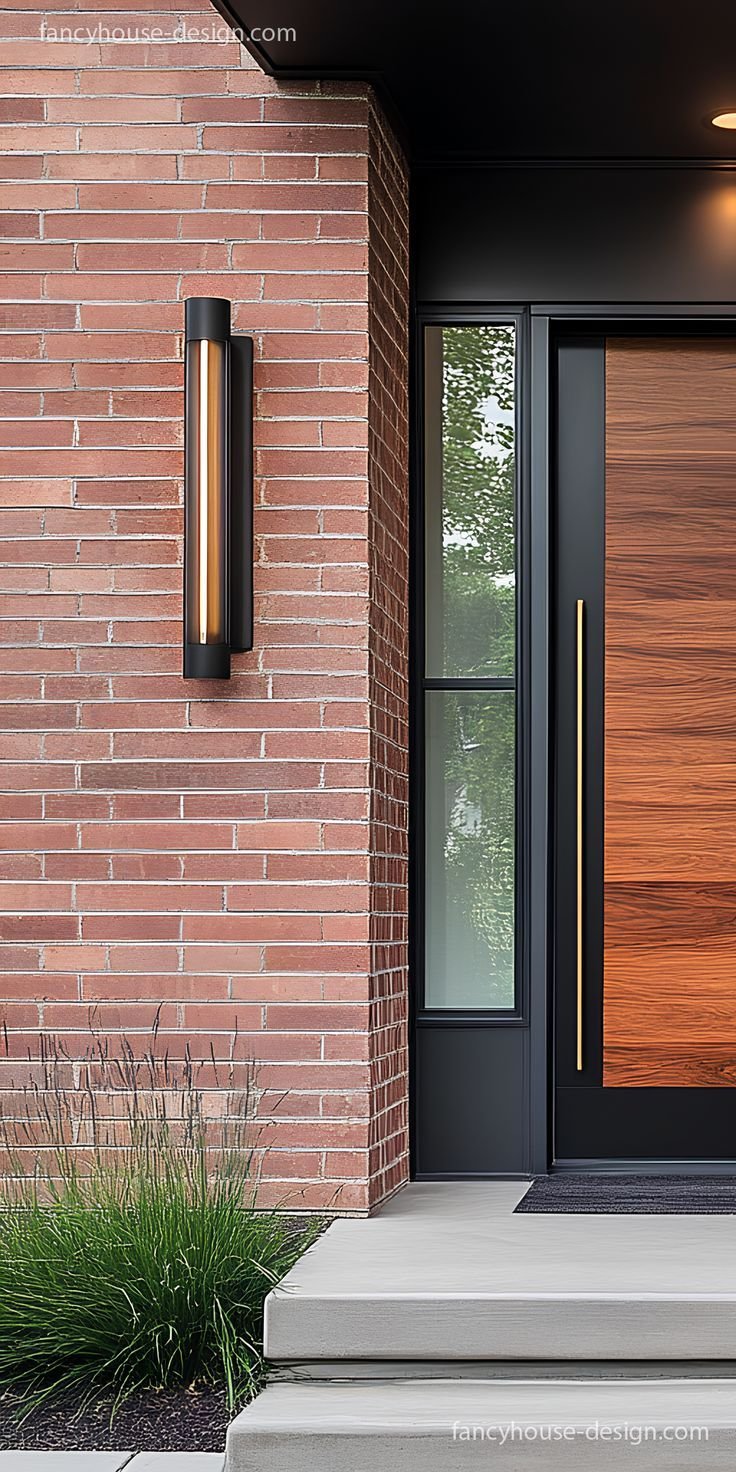
21. Elongated pull bar in brushed gold. A long pull bar on a front door does something specific: it makes the door look like it belongs somewhere beautiful. That’s not nothing.
22. Electronic entry with keypad. Functionally and aesthetically, the better versions of these are now genuinely good. No keys. Clean face. And they actually work in cold and wet weather, which matters.
23. Large-format address numerals. Numbers large enough to be read comfortably from the street, in a typeface that suits the architecture. This is a detail that most homes do inadequately and a few do beautifully. Be one of the few.
24. Integrated letter plate. The European solution to mail delivery. Cleaner than a wall box. Appropriate for homes that favor quiet, contained design.
Match your hinge finish to your handle finish. Mismatched hardware finishes are to an entry what a fraying hem is to an otherwise good outfit.
If you’re unable or unwilling to change the door itself, a hardware upgrade alone can change how it reads from the street more than almost any other single intervention. It’s also the most accessible change on this list.
Double Doors: The Architecture of Welcome
Double doors carry a specific cultural meaning. They say: come in. There is space. You are welcome here.
That’s worth creating when the opportunity exists.
25. Steel-framed glazed French entry. The thin steel grid creates a graphic quality that reads as both industrial and refined. The light that comes through transforms the foyer interior.
26. Double timber pivot doors. For homes with the proportion to support it, this combination is the most dramatic front entry configuration available in residential architecture.
27. Arched double doors with textured glass inserts. The softness of the arch balances the weight of the double-leaf format. The reeded or fluted glass inserts bring contemporary texture to a classically shaped opening.
28. Uneven-width double doors. An asymmetric pair with one wider and one narrower leaf. The asymmetry is unexpected and contemporary. The practicality is real.
Structural reality: expanding an existing opening to accommodate double doors requires engineering assessment. Do this before you fall in love with a pair of doors that your structure cannot accommodate without major work.
Minimalism: The Courage of Less
The most demanding design approach is also sometimes the most rewarding one.
Minimalism asks: what happens if we remove everything that isn’t essential? The answer, at its best, is beauty of a particular kind — resolved, quiet, complete.
29. The truly flush door. Perfect alignment between door face and facade plane. No frame. No reveal. No architrave. Just a clean join that announces itself only through the precision of its execution.
30. No-handle push plate entry. The complete absence of door hardware is its own kind of statement. A small push plate is all that distinguishes the door from the wall. When it opens, it is almost a surprise.
31. Matching door and wall finish. The door is painted — or clad — in an identical finish to the surrounding wall. It vanishes into the facade. The architecture is the entry.
32. Single thin vertical window in a solid door. One element, precisely placed. The proportion of glass to solid is the entire design decision. When it’s right, nothing else is needed.
33. Raw-texture composite panel. Concrete. Plaster. Board-form. For homes with an industrial character, a door that matches the material language of the structure completes the architectural intent.
Minimalism is not easier than ornamentation. It is harder. But when it works, the effect is a kind of clarity that stays with you.
Mid-Century Modern: Timeless Because It Was Genuinely Good
Mid-century modernism keeps “coming back” because it never actually went away. Its design principles — clarity of form, honesty of material, functional beauty — remain as applicable now as they were in 1955.
34. Geometric inlaid door panels. The era loved the diamond, the rectangle, and the starburst. Applied to a door panel in glass or contrasting timber, these forms carry their original energy intact.
35. Strong door color with a period-correct knocker. The mid-century door was not afraid of color. Orange. Yellow. Turquoise. Combined with the right hardware, it reads as historically informed and actively joyful.
36. Tongue-and-groove plank in teal. The color of the era on the material of the era. With clean-cut house numbers and simple round hardware, this is a combination that will outlast every current trend.
37. Flat panel with stacked square windows. Three windows, arranged vertically, in a flat panel door. Symmetrical. Resolved. The kind of design decision that is difficult to improve on.
The homes built between the late 1940s and early 1970s were designed with intention. When you work with that intention rather than against it, the results are almost always better than when you fight it.
Surrounds: The Frame That Completes the Picture
A door without a considered surround is a painting without a frame. The detail of how the door sits within the facade matters.
38. Panel cladding extended around the entry. Taking a board-and-batten or similar panel detail around the door frame creates a distinct entry zone — a focal point the eye finds naturally from the street.
39. Stone or tile cladding the door surround. The introduction of a heavier, more textural material around the entry creates contrast and depth that painted surfaces cannot provide.
40. A contrasting painted frame. If the facade is pale, a dark frame is the most immediate way to give the entry visual weight and clarity. It reads as a considered decision even when executed in a single afternoon.
41. Designed entry planting. Greenery flanking a front door softens the entry without diminishing it. The key is designing the planting rather than just placing pots.
42. A threshold space with atmospheric lighting. A door set back from the facade line creates a covered threshold. Add a pendant lamp or a carefully positioned downlight and the entry becomes somewhere you want to linger.
43. A generous entrance mat. The final detail. A mat that is large enough to feel intentional rather than token. The last word in an entry that has been thought through from the street all the way to the door.
The Entry You’re Proud to Come Home To
You’ve read 43 ideas. You know what your entry needs.
The remaining work is choosing which one to do first — and then actually doing it.
Not “saving” it for later. Not waiting for the “right time.”
Pick the change that matters most. Do it well. This season.
Your front door is the beginning of your home’s story. Make it the beginning you’d choose.